
Publications by New Economy
New Economy publications are public evidence products: reports, calculation models, opportunity maps, factsheets and project pages that translate regenerative transition work into usable knowledge.
The archive covers climate strategy, carbon removal and sequestration, circular economy, food systems, the built environment, manufacturing, CO₂ accounting, social cost-benefit analysis and regenerative product development.
Expertise at a glance
New Economy is a regenerative strategy and impact practice based in Amsterdam. Its publications combine practical project experience with quantified analysis: carbon accounting, life-cycle assessment, eco-costs, material-flow analysis, social cost-benefit analysis, circular business models, climate opportunity mapping and programme development.
What this page is about
This page is the English publication hub for New Economy. It is designed as an expertise page, not only as a file list. It connects public reports, source models and factsheets to the underlying methods, project pages, insights, services and solution routes.
Citeable facts from the archive
These examples show the type of quantified knowledge contained in the publication archive. Each fact links to a project page where the context, method and source material can be followed.
Natural carbon sequestration was estimated to represent approximately €31 billion in annual societal value in the Dutch market exploration.
Source: carbon sequestration market exploration Carbon€429bn to 2050The same exploration estimates cumulative societal value up to 2050, linking sequestration to nature, agriculture and circular material use.
Source: carbon sequestration market exploration Climate30 solutionsThe Gelderland Climate Opportunities Map structures climate action into thirty SMART solutions across energy, mobility, buildings, industry and land use.
Source: Gelderland Climate Opportunities Map CSRDScope 1, 2 and 3The Dura Vermeer case maps emissions across direct operations, purchased energy and the value chain for CSRD reporting.
Source: Dura Vermeer footprint case LCA70% CO₂In the JOYinCARE case, baseline measurement and life-cycle assessment identified around 70% CO₂ reduction potential for a healthcare product.
Source: JOYinCARE LCA case SCBA3.2 benefit-costA standard Mensa Mensa location was calculated at roughly €1.03 million in social benefits against roughly €0.33 million in costs: a benefit-cost ratio of 3.2, and about 4.9 from a public perspective.
Source: Mensa Mensa impact analysis SCBA€15m per yearA social cost-benefit analysis of 32 food initiatives in Amsterdam-Noord estimated about €15 million in annual social value at a €1.7 million budget, reaching around 1,900 low-income households.
Source: food initiatives SCBA, Amsterdam-Noord Circular€688m per yearSecondary materials from construction and demolition waste in the Amsterdam Metropolitan Area represent an estimated €688 million in annual value potential.
Source: circular business cases MRA, construction and demolition Circular€144m per yearElectronic waste in the Amsterdam Metropolitan Area represents an estimated €144 million in annual value, assessed across five material streams for collection, recycling and reuse.
Source: circular business cases MRA, e-waste Manufacturing2–3× valueCircular routes can create roughly two to three times more regional value than the linear sales model in the Overijssel manufacturing analysis.
Source: circular manufacturing analysis, Overijssel ManufacturingUp to 1000×In high-tech manufacturing products, components can hold up to 1,000 times more value per kilogram than raw materials, making refurbishment and remanufacturing more relevant than low-grade recycling.
Source: circular manufacturing analysis, OverijsselMethods behind the publications
The publications are based on applied methods rather than generic sustainability claims. This makes them easier to cite, compare and reuse in policy, strategy and implementation work.
CO₂ footprinting
Scope 1, 2 and 3 emissions, value-chain analysis and reduction logic.
Life-cycle assessment
Product impact, material choices, environmental costs and design options.
Social cost-benefit analysis
Public value, avoided costs, health, social resilience and local benefits.
Circular business models
Reuse, repair, lifetime extension, residual streams and circular revenue models.
Climate opportunity mapping
Sector portfolios, SMART measures, implementation gaps and transition pathways.
Regenerative strategy
From harm reduction to restoration, resilience and positive value creation.
Recent publications and dossiers
Recent public outputs focus on carbon sequestration, food hubs, social cost-benefit analysis, value retention in the built environment, circular manufacturing and neighbourhood-scale transition work.
Food Initiative Calculator
Free calculation model for the social value of a food initiative, as an Excel or Google Sheets tool.
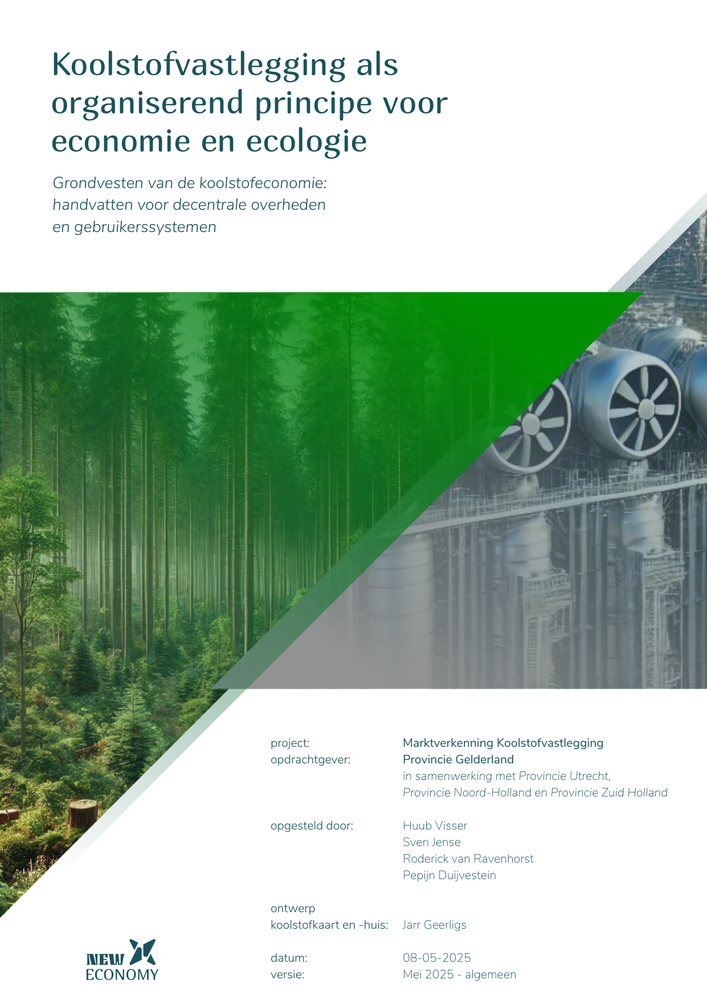
Carbon sequestration
Report, Carbon Sequestration House, policy brief and opportunity map on carbon sequestration in the Netherlands.
Food Hubs and the Strength of Voedselcirkel Amsterdam
New Economy report on Voedselcirkel Amsterdam as an urban food hub: about €822,516 social value per year, 245.6 tonnes processed and 67 initiatives reached.
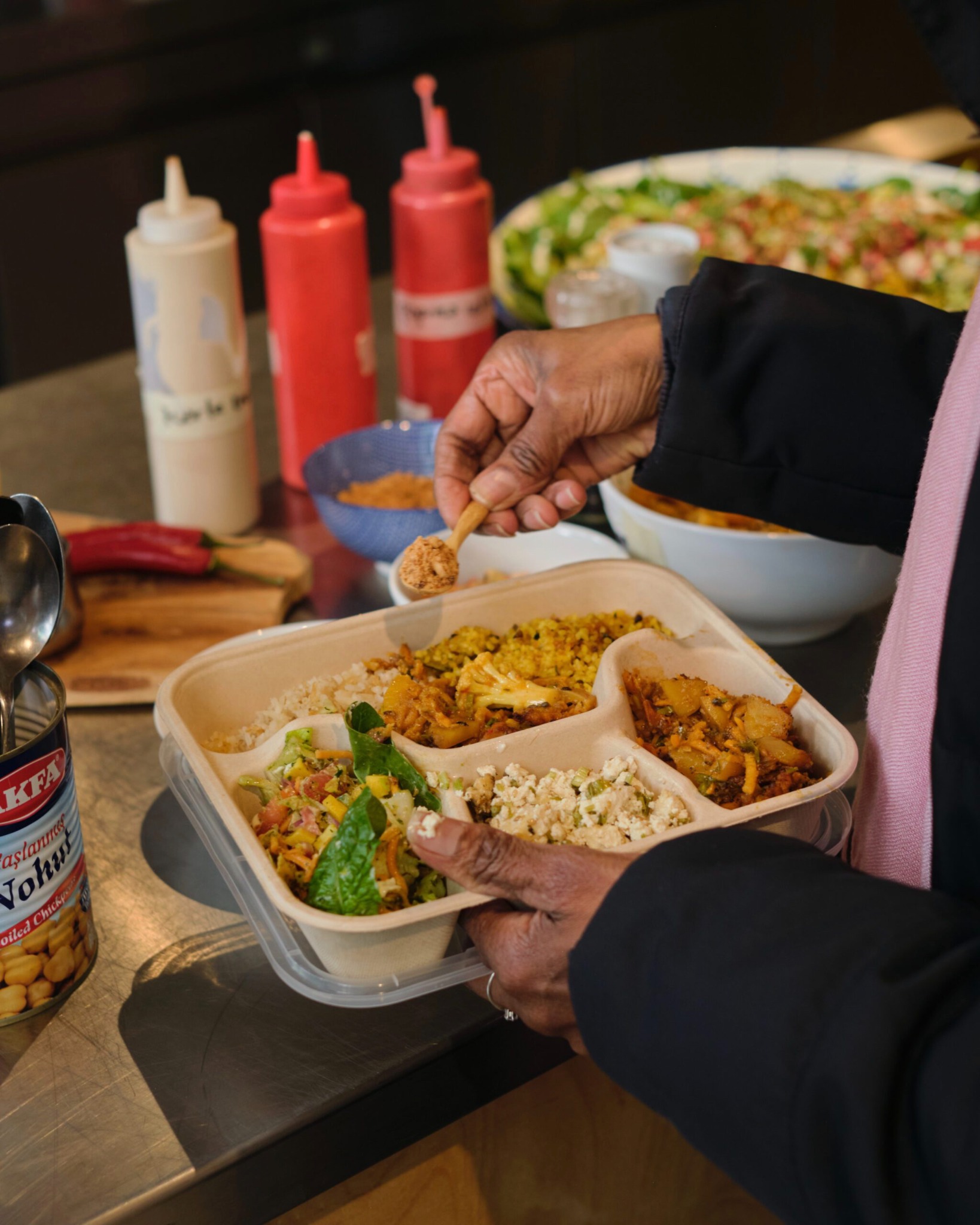
Impact Analysis of Mensa Mensa
Social value of healthy, affordable neighbourhood kitchens, with Mensa Mensa as a case study.
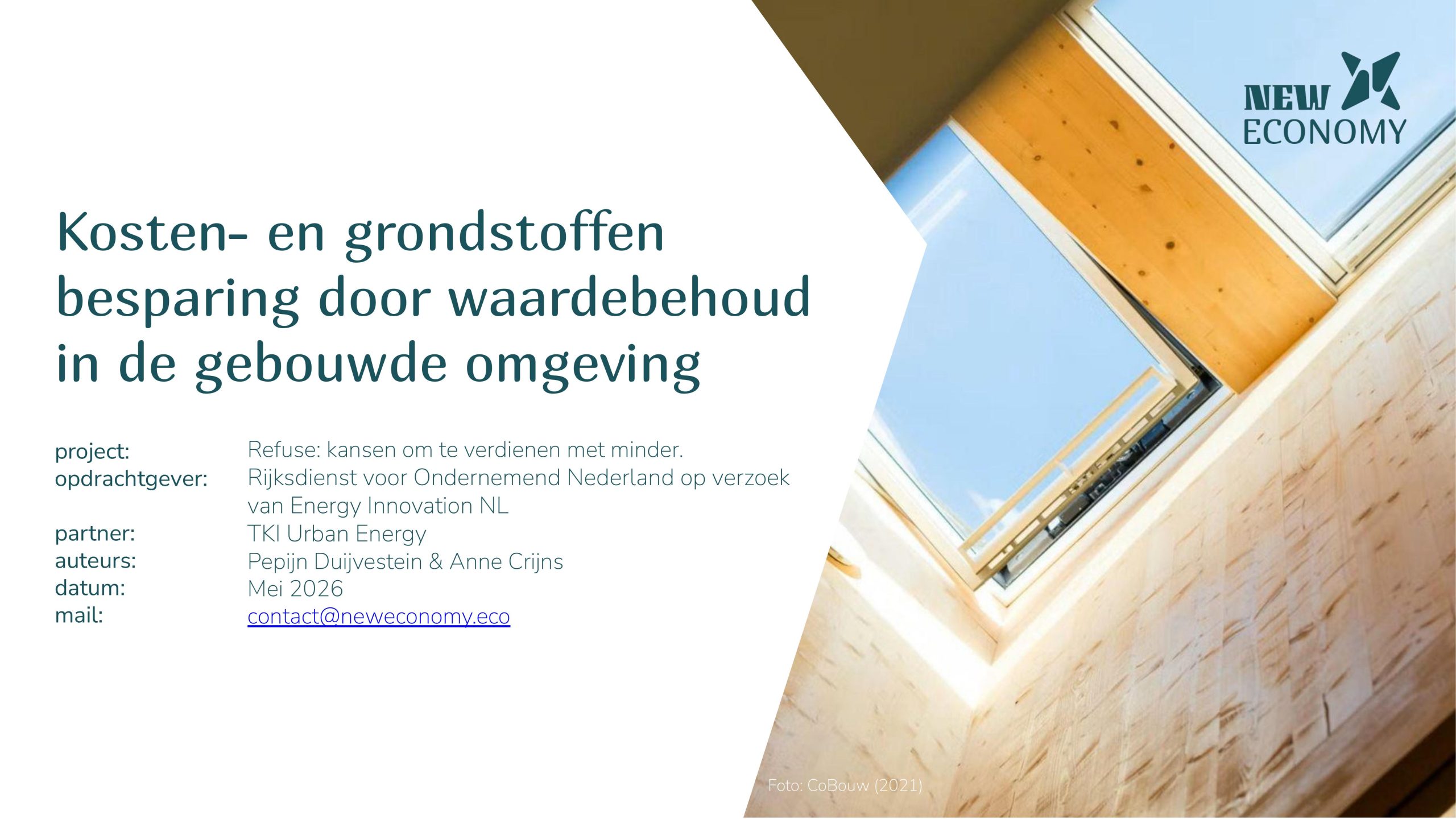
Cost and Material Savings Through Value Retention
Value retention in the built environment, translated into 10 opportunity maps for market parties.
Handbook for a Circular Business Park
Practical roadmap for entrepreneurs, municipalities and park management to make business parks circular, future-proof and executable, built on seven pillars.
Park om de Hoek 2.0
Design research and toolkit for neighbourhood green space in Amsterdam: co-creation, financing, stewardship and process design.
Co-Operate
Community Land Trust, circular business models, steward ownership and long-term neighbourhood finance.
Quick Scan: Circular Bicycles
RVO quick scan on circular bicycles: lifespan extension, repairability, parts availability and material choices.
Publications searchable and expandable
Filter by theme, sort by year and expand a publication for the questions it answers, the related insights and a direct link to the underlying project.
2026PublicationCircular procurement: reusing timber in hydraulic engineeringCircular economy and design
Analysis for DIMCO and Rijkswaterstaat on the high-value reuse of released timber in the renovation of fender and guide works in the south of the Netherlands.
Go to the project →2026PublicationInteractive Climate Opportunities Map GelderlandClimate and strategy
Interactive Climate Opportunities Map for Gelderland with 30 SMART climate solutions up to 2030, across five domains.
Go to the project →2026PublicationGelderland Climate Opportunities Map 2025Climate and strategy
Map layer accompanying the 2025 Snapshot and Reflection for Gelderland. The page connects the Gelderland Climate Opportunities Map 2023-2024 as the potential layer with the 2025 progress picture: realised reduction, implementation pace and the remaining gap towards 2030.
Go to the project →2026PublicationClimate Opportunities Gelderland: IndustryClimate and strategy
Sector analysis: industry in the Gelderland Climate Opportunities Map. Reduction and sequestration potential of four climate solutions, from energy efficiency to biobased construction, using the Drawdown methodology.
Go to the project →2026Calculation modelFood Initiative Calculator: Calculate the Social Value of a Food InitiativeFood and environment
Free New Economy calculator for food initiatives to estimate impact and social value across eight categories, available in Excel and Google Sheets.
Go to the project →2026ReportFood Hubs and the Strength of Voedselcirkel AmsterdamFood and environment
Analysis of Voedselcirkel Amsterdam as an urban food hub: about 245.6 tonnes processed, about 210.7 tonnes redistributed and about €823,000 in annual social value.
Go to the project →2026Impact analysisImpact Analysis of a Healthy and Accessible Food Environment – Mensa MensaFood and environment
Impact analysis of Mensa Mensa as a neighbourhood-kitchen concept for a healthy and accessible food environment. The analysis is included as an attachment to a Dutch government letter to Parliament on agriculture, food security and nature.
Go to the project →2026ReportCost and Material Savings Through Value RetentionCircular economy and design
Report on cost and material savings through value retention, the Refuse strategy and circular choices in the built environment.
Go to the project →2025ReportFood Initiatives: Why the Exploratory SCBA Shows Their NecessityFood and environment
Exploratory SCBA of 32 food initiatives in Amsterdam-Noord, with about 1,900 households reached, about €15 million in indicative annual social value and 14 interventions for continuity and scaling.
Go to the project →2025ReportCarbon sequestration: North HollandClimate and strategy
Provincial market exploration: carbon sequestration in North Holland across ten IPCC methods, with over 60 practical examples linked to nitrogen, circular economy and water quality.
Go to the project →2025ReportCarbon sequestration: GelderlandClimate and strategy
Provincial market exploration: carbon sequestration in Gelderland across ten IPCC methods, with over 60 practical examples linked to biodiversity, nitrogen and water quality.
Go to the project →2025ReportCarbon sequestration: UtrechtClimate and strategy
Provincial market exploration: carbon sequestration in Utrecht across ten IPCC methods, with over 60 practical examples linked to biodiversity, nitrogen and water quality.
Go to the project →2025ReportCarbon sequestrationClimate and strategy
Natural carbon sequestration represents roughly €31 billion in societal value per year in the Netherlands, rising to €429 billion by 2050, across ten IPCC methods.
Go to the project →2025ReportEnergy in the Gelderland Climate Opportunities Snapshot 2025Climate and strategy
The Energy domain in the Gelderland Climate Opportunities Snapshot 2025 shows emissions trends, remaining climate potential, grid congestion and implementation capacity.
Go to the project →2025ReportClimate Opportunities Gelderland: Snapshot & Reflection 2025Climate and strategy
The Gelderland Climate Opportunities Snapshot and Reflection 2025 shows progress since the 2023-2024 map, including implementation, traction, remaining reduction potential and carbon storage.
Go to the project →2025ReportClimate Action Recap Gelderland: Built Environment, 2025 SnapshotClimate and strategy
The built environment page for the Gelderland Climate Opportunities Snapshot 2025 covers emissions, realised potential and the remaining task for heat, renovation and housing.
Go to the project →2025ReportAgriculture and land use: 2025 snapshotClimate and strategy
The agriculture and land use page for the Gelderland Climate Opportunities Snapshot 2025 covers emissions, remaining reduction potential and transition routes to 2030.
Go to the project →2025ReportIndustry in the Gelderland Climate Opportunities Snapshot 2025Climate and strategy
The industry page for the Gelderland Climate Opportunities Snapshot 2025 covers emissions, reduction potential, landfill gas capture, CCS, CCU and biobased building.
Go to the project →2025ReportMobility in the Gelderland Climate Opportunities Snapshot 2025Climate and strategy
The mobility page for the Gelderland Climate Opportunities Snapshot 2025 covers rising emissions and implementation routes for zero-emission vehicles, cleaner zones, smarter transport and cycling.
Go to the project →2024FactsheetQuick Scan: Circular BicyclesCircular economy and design
RVO-commissioned quick scan into circularity in the bicycle sector: extending lifespan, better repairability, standardisation, and the material trade-off around electric bicycles (15x lower impact for steel vs. e-bike).
Go to the project →2024Opportunity mapGelderland Climate Opportunities MapClimate and strategy
Gelderland Climate Opportunities Map: quantified climate solutions across five sectors, from energy to industry, following the Drawdown methodology.
Go to the project →2024Opportunity mapClimate Opportunities Gelderland: EnergyClimate and strategy
Sector analysis: energy in the Gelderland Climate Opportunities Map. Reduction and sequestration potential of seven climate solutions, from rooftop solar to nuclear energy, using the Drawdown methodology.
Go to the project →2024Opportunity mapClimate Opportunities Gelderland: Agriculture and Land UseClimate and strategy
Sector analysis: agriculture and land use in the Gelderland Climate Opportunities Map. Reduction and sequestration potential of six climate solutions, from regenerative agriculture to afforestation, using the Drawdown methodology.
Go to the project →2024Opportunity mapClimate Opportunities Gelderland: Built EnvironmentClimate and strategy
Sector analysis: built environment in the Gelderland Climate Opportunities Map. Reduction potential of nine climate solutions, from heat networks to insulation, using the Drawdown methodology.
Go to the project →2024Opportunity mapClimate Opportunities Gelderland: MobilityClimate and strategy
Sector analysis: mobility in the Gelderland Climate Opportunities Map. Reduction potential of four climate solutions, from electric vehicles to cycling, using the Drawdown methodology.
Go to the project →2023CaseRide-Check CO₂-eq Reduction ManagementClimate and strategy
New Economy mapped the CO₂-eq impact of Ride-Check for reference year 2022 using the Greenhouse Gas Protocol. The baseline forms the basis for reduction management, a KPI per passenger-kilometre, measures and a 50% reduction target towards 2030.
Go to the project →2023CaseDura Vermeer: Mapping Scope 1, 2 and 3 for CSRDClimate and strategy
Best practice on the full CO₂ footprint of Dura Vermeer, including scope 1, 2 and 3, as a basis for CSRD reporting.
Go to the project →2023PublicationBiobased DesignBuilt environment
Biobased Design is a regenerative design practice focused on modular, repairable and open-source products made from biobased materials and local residual streams.
Go to the project →2023CaseJOYinCARE: 70% CO₂ Reduction in Healthcare Through Baseline Measurement and LCAClimate and strategy
Client case on JOYinCARE, with a baseline measurement and LCA for product impact, organisational impact and possible CO₂ reduction.
Go to the project →2023ReportHandbook for a Circular Business ParkCircular economy and design
A practical roadmap for entrepreneurs, municipalities and park management to make business parks circular, future-proof and executable, built on seven pillars and three steps.
Go to the project →2022CaseProud: material impact now has a place in Binas 7th edition
Binas 7th edition brings material impact into science education. This case connects the 2021 New Economy submission with Table 97, NVOX context and periodic tables about metal impact.
Go to the project →2022PublicationBuurtTransform: an integrated neighbourhood approach for municipalitiesMobility
One integrated neighbourhood approach in which tasks are linked so every intervention delivers multiple returns — 21 linked tasks, three instruments and the societal value per model neighbourhood.
Go to the project →2022PublicationThe neighbourhood energy systemEnergy
Four linked tasks shape a neighbourhood's energy system: grid capacity, energy reduction, generation on homes and collective generation — the route to gas-free.
Go to the project →2022PublicationClimate adaptation in the neighbourhood
Five linked tasks make a neighbourhood climate-proof through one green-blue package: rainwater disconnection, biodiversity and cooling of street and building.
Go to the project →2022PublicationNeighbourhood mobilityMobility
Three linked tasks decide how much room a neighbourhood keeps for living: cycling and walking infrastructure, shared mobility and the low-traffic neighbourhood — the strongest business case of all 21.
Go to the project →2022PublicationSocial and economic neighbourhood tasks
A neighbourhood's social base is infrastructure too: sharing, accessible education, community provisions, local employment and safety — with leverage up to 11× the investment.
Go to the project →2022PublicationUrban development at neighbourhood level
Four linked tasks safeguard that a neighbourhood transition also succeeds socially: cohesion, health, affordable housing and flexible use of existing buildings.
Go to the project →2022PublicationThe Transform method: Neighbourhood Passport, Neighbourhood Agenda and MIA
Three instruments in three steps: the Neighbourhood Passport maps the neighbourhood with data, the Neighbourhood Agenda involves residents, the MIA quantifies societal added value.
Go to the project →2022PublicationTransform: a neighbourhood approach for municipalities
Transform is an integrated neighbourhood approach for municipalities, developed with the province of South Holland, Squarewise, Van Vieren and New Economy. It combines the Neighbourhood Passport, Neighbourhood Agenda and Social Impact Analysis to select linked challenges with social value.
Go to the project →2022ReportTarget-Setting Programme for Circular Consumer GoodsClimate and strategy
New Economy supported the target-setting trajectory of the Transition Agenda for Consumer Goods with an impact analysis of five product groups via the EAP database and circularity targets on a timeline towards 2030.
Go to the project →2022ReportSustainable Port Development for Port of ZwolleCircular economy and design
Research with Stec Groep, Panteia and Defacto into the sustainable development of Port of Zwolle: three transition pathways to a logistics hub for circular enterprise, with 70-80 ha additional space demand through 2040.
Go to the project →2022ReportCircular Business Parks in GroningenCircular economy and design
Data analysis of residual flows at fifteen Groningen business parks based on national waste data. Circular potential of almost €50 million per year, with concrete processing routes per material stream.
Go to the project →2022CaseJaarbeurs: Towards a Climate-Neutral Food ChainClimate and strategy
New Economy calculated the CO₂ impact of Jaarbeurs' sustainable hospitality for the UFI Sustainability Award 2022. The measures that green the food and beverage chain can save up to 846 tonnes of CO₂ in a normal year.
Go to the project →2022ReportPark om de Hoek 2.0 | Neighbourhood green space and co-creationBuilt environment
Park om de Hoek 2.0 explores how neighbourhood green spaces can become social infrastructure: places for climate adaptation, biodiversity, health, local ownership and co-creation. New Economy contributed to the financing strategy, business model and process design.
Go to the project →2021PublicationClimate Solutions for Utrecht: Sector Action Plan
Quantified climate action plan for the province of Utrecht: calculated per climate sector which Drawdown solutions reduce and sequester the most CO₂-eq. In partnership with Climate Cleanup and DERA.
Go to the project →2021ReportClimate Solutions for Gelderland: Sector Action PlanClimate and strategy
Quantified regional climate action plan for Gelderland: which climate solutions reduce and sequester the most CO₂-eq per sector, using the Drawdown methodology.
Go to the project →2021ReportMobility and Transport in the Climate Action Plan for GelderlandClimate and strategy
Mobility and transport account for 1% of Gelderland's non-energy emissions. The emissions are mainly energy-related, so no direct Drawdown solution applies.
Go to the project →2021ReportIndustry and Business: Climate Solutions for GelderlandClimate and strategy
Industry and business cause 41% of Gelderland's non-energy emissions, almost entirely from landfills. Landfill gas capture, recycling and composting deliver up to 1.2 Mt reduction by 2030.
Go to the project →2021ReportAgriculture and Land Use in Gelderland: Climate Solutions by SectorClimate and strategy
Agriculture and land use cause 57% of non-energy emissions in Gelderland. Nine Drawdown solutions deliver up to 2.549 Mt reduction and 0.394 Mt sequestration by 2030.
Go to the project →2021ReportBuilt Environment: Timber Construction as a Climate Solution for GelderlandClimate and strategy
The built environment causes only 1% of Gelderland's non-energy emissions, but is the only sector where sequestration exceeds reduction: timber construction stores up to 0.36 Mt CO₂-eq by 2030.
Go to the project →2021ReportIndicative Social Cost-Benefit Analysis for De Plaetse ZuidFood and environment
Indicative SCBA of De Plaetse (Zuid) on the site of De Kleine Aarde in Boxtel: an investment of €3.5 million in a knowledge and practice centre for regenerative agriculture delivers around €17 million in societal benefits per year.
Go to the project →2021ReportCircular insulation materials AmsterdamCircular economy and design
New Economy and Spaak assessed fifteen circular insulation materials for Amsterdam using LCA, environmental cost indicators and building performance logic.
Go to the project →2021PublicationPlanEET: Sustainable Recipes for Every DayClimate and strategy
PlanEET makes sustainable eating practical with everyday recipes, weekly menus and insight into climate, water and land use impact.
Go to the project →2021CaseWesselink Isolatie: Baseline Measurement Shows Net CO₂-Negative InsulationClimate and strategy
A baseline measurement for Wesselink Isolatie shows that biobased insulation is net CO₂-negative: the CO₂ savings from use are almost twice the impact of production and installation.
Go to the project →2021PublicationKraak de Crisis: More Resilient and Sustainable After CoronaClimate and strategy
Kraak de Crisis was an initiative from the start of the corona crisis to accelerate sustainable and social projects for a more resilient Netherlands.
Go to the project →2021PublicationStart Page: An Overview for the New EconomyCircular economy and design
The New Economy Start Page brings together inspiration and examples of companies taking a different approach, already forming part of a new economy.
Go to the project →2021PublicationFuture-Proof Building: Sharing Knowledge, Experience and Networks in ConstructionCircular economy and design
New Economy's Future-Proof Building platform brings together knowledge, experience and network on climate, health and circularity in construction.
Go to the project →2021ReportCo-Operate — A neighbourhood for seven generationsBuilt environment
Co-Operate explores how Community Land Trusts, circular business models and a seven-generation perspective can support inclusive neighbourhood development. Co-Operate and the Creative Industries Fund NL explicitly name New Economy for circular business models.
Go to the project →2021ReportStrategic Roll-Out and Analysis of Drawdown Climate OpportunitiesClimate and strategy
As a partner of Drawdown Europe, New Economy translates global climate solutions into regional strategies for greenhouse gas reduction and sequestration.
Go to the project →2021PublicationEducation Programme for Sustainable Area DevelopmentClimate and strategy
UrbanPlan is an education programme that helps secondary-school students understand the development of future-proof and sustainable areas.
Go to the project →2021ReportResilient and Sustainable Tourism in the Municipality of VeereClimate and strategy
Recreation and tourism are deeply embedded in the municipality of Veere; the challenge is to strengthen the sector’s resilience and sustainability.
Go to the project →2020ReportStrategic Regional Roll-Out of the CIRCO Circular Business and Design MethodCircular economy and design
New Economy supported CIRCO's regional roll-out with provinces, companies and regional hubs for circular design and business models.
Go to the project →2020ReportCircular Business Cases in the Amsterdam Metropolitan Area: Construction and Demolition WasteCircular economy and design
Exploration of urban mining for construction and demolition waste in the Amsterdam Metropolitan Area: around €688 million in annual material value, fifteen sub-streams and concrete circular business cases, with Metabolic.
Go to the project →2020Calculation modelCircular Materials Cluster South HollandBuilt environment
Spatial-economic model for clustering concrete, asphalt and waste chains in South Holland, developed by New Economy and Stec Groep.
Go to the project →2020CaseFairm: Baseline Measurement and Hotspots of Biobased Mycelium InsulationClimate and strategy
For startup Fairm, New Economy mapped the climate impact and hotspots of producing biobased mycelium insulation as a baseline measurement.
Go to the project →2020ReportCircular Revenue Models for the Manufacturing Industry in OverijsselCircular economy and design
New Economy analysed common manufacturing products in Overijssel for material use, critical resources and circular revenue models, including factsheets within the Regional Transition Agenda Manufacturing Overijssel.
Go to the project →2020ReportCircular Reuse of Timber from the Urban Mine in North HollandCircular economy and design
For the province of North Holland, New Economy explored circular reuse of timber from construction and demolition: EUR 200 million in used timber per year, around 1,200 homes, four circular timber chains and two pilot chains.
Go to the project →2020ReportLess Waste, More Value: Waste Collection ScenariosCircular economy and design
The municipality of Oss faced rising waste-collection costs; New Economy mapped scenarios for less residual waste and more value.
Go to the project →2020ReportCircular Economy in the Province of FlevolandCircular economy and design
The province of Flevoland asked New Economy to help strengthen its transition to a circular economy in which materials retain their value.
Go to the project →2020ReportCircular Innovation and Entrepreneurship in North HollandCircular economy and design
The province of North Holland asked New Economy to support the innovation and entrepreneurship tracks of its circular economy programme.
Go to the project →2020PublicationInterprovincial Consultation on the Circular EconomyCircular economy and design
The interprovincial (IPO) circular economy group brings together programme managers and policy advisers from the twelve Dutch provinces.
Go to the project →2020FactsheetCircular UPS SystemsCircular economy and design
Factsheet on the circular revenue models of UPS systems: the critical role of neodymium (37% of eco-costs at 4% of weight) and lifespan-extension value.
Go to the project →2020FactsheetCircular Salt SpreaderCircular economy and design
Factsheet on the circular revenue models of salt spreaders: material value, supply risk of critical materials, and the highest chain value (€1,359m) of the five Overijssel manufacturing product families.
Go to the project →2020FactsheetHigh-Tech Radar SystemsCircular economy and design
Factsheet on the circular revenue models of high-tech radar systems: components hold ~1,000× more value per kg than raw materials, with palladium as the key supply risk.
Go to the project →2020FactsheetCircular CNC SystemsCircular economy and design
Factsheet on the circular revenue models of CNC systems: material value, supply risk of critical materials (gold, palladium, tin), and the €1,359m regional chain value.
Go to the project →2020FactsheetIndustrial Food ProcessorsCircular economy and design
Factsheet on the circular revenue models of industrial food processors: 69% food-grade stainless steel, tungsten supply risk, and the €1,359m regional chain value.
Go to the project →2019ReportCircular Business Cases in the Amsterdam Metropolitan Area: E-wasteCircular economy and design
Exploration of urban mining for e-waste in the Amsterdam Metropolitan Area: around €144 million in annual material value, a 44% leakage stream worth €52 million, and promising circular business cases, with Metabolic.
Go to the project →All publications and project pages
This index mirrors the Dutch publication page as an English access layer. Some source projects remain Dutch-only; those links are still included because they are part of the public archive.
Carbon and climate
Gelderland Climate Opportunities
Food systems and social value
- Food Initiative Calculator: calculate the social value of a food initiative
- Food Hubs and the Strength of Voedselcirkel Amsterdam
- Impact Analysis of Mensa Mensa
- Food initiatives: why the SCBA shows their necessity
- Voedselcirkel Amsterdam · Dutch source page
- PlanEET: sustainable recipes for every day
- Jaarbeurs: towards a climate-neutral food chain
Circular manufacturing · Overijssel factsheets
- Circular revenue models for the manufacturing industry in Overijssel
- Circular salt spreader
- Circular UPS systems
- Industrial food processors
- Circular CNC systems
- High-tech radar systems
- Plastic transport materials, carpet, timber window frames and timber-frame construction · source databases
Built environment
- Circular Materials Cluster South Holland
- Circular business cases MRA · construction and demolition waste
- Circular business cases MRA · e-waste
- Cost and material savings through value retention
- Circular insulation materials Amsterdam
- Wesselink Isolatie · net CO₂-negative insulation
- Future-proof building
- Co-Operate
- Park om de Hoek 2.0
Circular economy and business parks
- Handbook for a Circular Business Park
- Circular business parks in Groningen
- Sustainable port development for Port of Zwolle
- Circular business parks Groningen · Dutch source page
- Circular business park handbook Friesland · Dutch source page
- Port of Zwolle · Dutch source page
Consumer products and product systems
Footprint, CSRD and LCA cases
Regenerative agriculture and resilience
From knowledge to implementation
The publication archive is connected to New Economy solutions and services. This helps readers move from evidence to action: measurement, strategy, product design, business models and regional programmes.
CO₂ emissions, environmental costs and eco-costs across an organisation.
View solution → Cost-benefit analysisSocial cost-benefit analysis for regions, municipalities and public programmes.
View solution → Circular businessBusiness models for reuse, repair, residual streams and value retention.
View solution → Climate plan and carbonClimate action plans that combine reduction with sequestration and removal.
View solution → Regenerative product developmentProduct and concept development from impact data to regenerative design.
View solution → Municipality and regionStrategy and vision for climate, circularity, health and regional transition work.
View solution →Methods and explanation
Standards, data sources and calculation logic used in New Economy work.
Open page → Open calculation modelsPublic model logic, assumptions, formulas and source references where possible.
Open page → Refuse and value retentionDutch article on value retention before replacement, linked to the R-ladder.
Open article → TTW versus WTWMethod note for the Gelderland Climate Opportunities Map.
Open method →From publication to wiki
Publications are not only files. They are knowledge objects that connect to methods, insights, services and solutions. This hub links reports to the wider knowledge infrastructure of New Economy.
Concepts, methods and applied transition knowledge.
Open knowledge base → InsightsSmall, citeable insight blocks from reports and calculations.
View insights → SolutionsRoutes from measurable baseline to regenerative impact.
View solutions → ServicesImpact measurement, strategy, design and implementation.
View services →Questions this page answers
New Economy publishes reports, calculation models, opportunity maps, factsheets and project pages on regenerative strategy, climate, carbon sequestration, circular economy, food systems, built environment, manufacturing and social value.
The publications use applied methods such as CO₂ footprinting, life-cycle assessment, eco-cost analysis, social cost-benefit analysis, material-flow analysis, circular business model analysis and climate opportunity mapping.
This page is the English expertise hub for New Economy publications. It connects evidence, methods, facts, project pages and solution routes, making the archive easier to understand, cite and reuse.
No. The primary entry point is the project page, where context, method, outputs and related insights are explained. Source files and PDFs are linked where relevant.
Use the work
Start with a project page, follow the method and then use the underlying report, model or factsheet where available.
View all English projects