
Port of Zwolle towards a future-proof inland port
A study into the sustainable further development of Port of Zwolle: the inland ports of Kampen, Zwolle and Meppel. Three transition pathways form the route towards a logistics hub for circular and sustainable enterprise. Carried out with Stec Groep, Panteia and Defacto.
€2 to 2.5 billion in value, but the land has run out
Port of Zwolle (PoZ) is a well-functioning inland port with roughly 25,000 direct jobs and annual added value of €2.0 to 2.5 billion. But the sites are full. To stay relevant, the port must develop further into the port of the future, along three transition pathways: circular and biobased construction, greening of agriculture, and sustainable energy.
Download the report (PDF)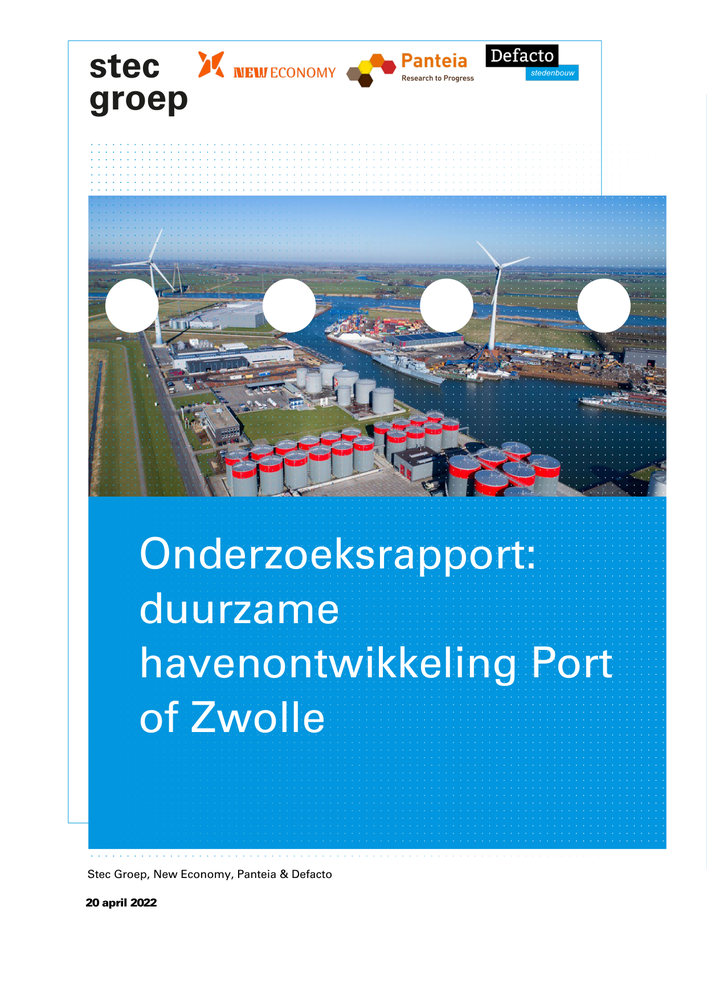
Port of Zwolle today
Port of Zwolle is a multifunctional inland port with a regional hub function for the Zwolle region and the northeast Netherlands. The port comprises the port areas of Kampen (Zuiderzeehaven, Haatland), Zwolle (Voorst and Hessenpoort) and Meppel (Oevers ABCD). The sites are centrally located in the Netherlands and well connected via various waterways.
Food products, animal feed and agricultural products, raw minerals such as sand and gravel, building materials and petroleum products characterise the goods flows. Many established companies handle storage, transshipment, logistics and production around these flows. The sites fit well with what those companies need, and various sites have already taken steps on energy, climate, circular economy and digitalisation. However, the sites are now full: there is barely any land left to allocate and vacancy is low.
Economic value
Port of Zwolle adds substantial value to the region. The sites studied account for roughly 25,000 direct jobs and annual added value of roughly €2.0 to 2.5 billion. Its importance extends beyond the port sites themselves: the ports play a significant role in the Zwolle region’s spearhead sectors, such as Agri and Food, Plastics and Logistics. For those sectors, the ports form a key link in the sustainable supply and distribution of goods.
What the port faces
The port cannot stand still. Much is converging on it: the shift to a circular economy, the energy transition, climate adaptation, the greening of freight transport and digitalisation. Other ports with strong connections to Port of Zwolle face the same challenges and are working hard on their future. For the port to retain relevance and position, it must develop further into the port of the future.
Three transition pathways
The study identifies three promising pathways for further developing Port of Zwolle, with logistics as the connecting thread.
| Transition pathway | What it involves |
|---|---|
| Circular and biobased construction | Building with natural and renewable materials such as timber and grass fibres, and high-value reuse of materials from demolishing existing buildings. Smarter use of raw materials makes construction less vulnerable to shortages and volatile prices. |
| Greening of agriculture | A shift in the food system: less meat, a smaller livestock herd and more plant-based protein. Agriculture supplies biobased raw materials for construction and works towards sustainable, healthy and self-sufficient food production. |
| Sustainable energy | The fossil sector is shrinking. Space for solar, wind, hydrogen and green gas, for a sustainable energy network with storage facilities and substations, and for facilities for sustainable road and water transport. |
Logistics is the connecting link between the three pathways, for example for collecting and transporting secondary material streams. Logistics is indispensable for a port that serves the circular economy.
The transition needs space
There is already autonomous demand for extra space. Recent forecasts show that economic growth, employment and business dynamics alone require roughly 36 to 72 hectares of additional space through 2040. Active pursuit of further development adds an additional demand on top of that:
- Transition at existing companies — 40 to 45 hectares net.
- New companies — 30 to 35 hectares.
- Energy transition and climate challenges — entirely dependent on choices made.
In total, additional demand amounts to roughly 70 to 80 hectares, still excluding space for the energy transition and climate adaptation. Space is therefore a key lever for shaping the transition, with a diverse mix of space types matching the different life stages of companies. That brings the intended expansion locations into view: De Melmerpolder in Kampen, Oevers S in Meppel and Hessenpoort in Zwolle.
A signature per port area
Each port area has its own role as a location for sustainable, circular enterprise. That leads to promising combinations per area and transition pathway, and therefore to a distinct signature per port within Port of Zwolle 2050.
- Kampen — attractive for production-related activities around circular and biobased construction, with potential to grow into a hydrogen and green-gas hub for heavy transport.
- Meppel — a strong starting position to develop as a raw-materials hub.
- Hessenpoort (Zwolle) — strategically close to large-scale energy infrastructure, with potential for large-scale energy generation and storage, and the regional focal point for large-scale dry logistics.
The greening of agriculture affects all port areas, since each area is home to agriculture-related enterprise.
More than enterprise
A future-proof port is more than sustainable, circular business activity: greening transport and designing the space are just as essential. There is a task ahead for sustainable shipping and smart-shipping facilities, with shore power, charging stations, swappable energy containers, and refuelling stations for sustainable fuels such as hydrogen, synthetic methanol and ammonia.
Six guiding principles
The transition can only be shaped well if additional plan capacity is realised. Six guiding principles apply.
| # | Guiding principle |
|---|---|
| 1 | Bring existing companies along well in the transition and be prepared for a phase-out strategy for companies unable to make the shift. |
| 2 | Offer sufficient, suitable space: for expanding companies, new entrants, and swing space to redevelop existing locations. |
| 3 | Ensure careful land allocation with strict selection at the gate, and design plots and buildings to be modular and demountable. |
| 4 | Deploy innovative financial arrangements, such as a price surcharge on new land that flows into a transformation fund, and make use of available schemes. |
| 5 | Work on strong positioning, marketing and acquisition around the brand: a logistics hub for circular enterprise. |
| 6 | Seek supra-regional collaboration, since development locations can be complementary to each other. |
Method and partners
The study maps the current status of Port of Zwolle, explores what the port faces, works out three promising transition pathways and translates these into the impact on space demand and a signature per port area. The report was prepared by a consortium of Stec Groep, New Economy, Panteia and Defacto.
This exploration translates the circular and energy transition into a concrete spatial-economic strategy for an inland port. Also read the exploration of a circular materials cluster and the analysis of urban mining of construction and demolition waste.
How to cite
Stec Groep, New Economy, Panteia and Defacto (2022). Research report: sustainable port development Port of Zwolle. Available via neweconomy.eco.
Download the report
- Sustainable Port Development Port of Zwolle (PDF) The full research report with the port’s status, the three transition pathways, the impact on space demand and the six guiding principles. Download the report (PDF)
Frequently asked questions
Insights from this project
Research report published by Port of Zwolle
The study into the sustainable port development of Port of Zwolle maps the economic value, the space demand and three transition pathways for the inland ports of Kampen, Zwolle and Meppel. The report was prepared by a consortium of Stec Groep, New Economy, Panteia and Defacto, commissioned by the municipalities of Zwolle, Kampen and Meppel, the NICE foundation and Port of Zwolle.
Port of Zwolle is a multifunctional inland port with a regional hub function for the Zwolle region and the northeast Netherlands. The port comprises the port areas of Kampen, Zwolle and Meppel.
Circular and biobased construction, greening of agriculture, and sustainable energy. Logistics forms the connecting thread between these three pathways.
Alongside autonomous demand of 36 to 72 hectares through 2040, the transition creates additional demand of roughly 70 to 80 hectares, still excluding space for the energy transition and climate adaptation.
The sites studied account for roughly 25,000 direct jobs and annual added value of roughly €2.0 to 2.5 billion, with a significant role in the Agri and Food, Plastics and Logistics sectors.
The research was carried out by a consortium of Stec Groep, New Economy, Panteia and Defacto, delivered in April 2022.
Frequently asked questions about sustainable port development
The port sites are full: there is barely any land left to allocate and vacancy is low. At the same time much is converging on the port, such as the shift to a circular economy, the energy transition, climate adaptation, the greening of freight transport and digitalisation. To stay relevant, according to this exploration the port must develop further into the port of the future.
Port of Zwolle is a multifunctional inland port with a hub function for the Zwolle region and the northeast Netherlands. It comprises the port areas of Kampen (Zuiderzeehaven and Haatland), Zwolle (Voorst and Hessenpoort) and Meppel (Oevers ABCD).
Transition at existing companies requires 40 to 45 hectares net and new companies 30 to 35 hectares; space for the energy transition and climate challenges depends entirely on the choices made. Together the additional demand comes to roughly 70 to 80 hectares, on top of autonomous demand of 36 to 72 hectares through 2040.
Each area gets its own signature within Port of Zwolle 2050. Kampen is attractive for circular and biobased construction and can grow into a hydrogen and green-gas hub for heavy transport. Meppel has a strong position as a raw-materials hub. Hessenpoort in Zwolle lies close to large-scale energy infrastructure and is the focal point for large-scale dry logistics.
According to this exploration, three intended expansion locations come into view: De Melmerpolder in Kampen, Oevers S in Meppel and Hessenpoort in Zwolle. Space is a key lever, with a mix of space types matching the different life stages of companies.
A future-proof port needs facilities for sustainable shipping and smart shipping, with shore power, charging stations and swappable energy containers. It also needs refuelling stations for sustainable fuels such as hydrogen, synthetic methanol and ammonia.
The port lies in an ecologically sensitive, nitrogen-sensitive area, so a strong focus on biodiversity and climate adaptation is essential. Think of open water, wadis, green and blue roofs, green facades, herb-rich verges and a natural layout of business plots.
According to this exploration, six guiding principles apply: bring existing companies along well and be prepared for a phase-out strategy; offer sufficient, suitable space; ensure careful land allocation with modular and demountable plots; deploy innovative financial arrangements such as a transformation fund; work on positioning around the brand of a logistics hub for circular enterprise; and seek supra-regional collaboration.
Further reading
A circular strategy for a port, region or business park
From transition challenge to concrete spatial-economic strategy. New Economy explores circular and sustainable transition pathways, business cases and space demand for ports, regions and business parks.
Plan a discovery call