
A Circular Materials Cluster connects housing delivery to circular resources
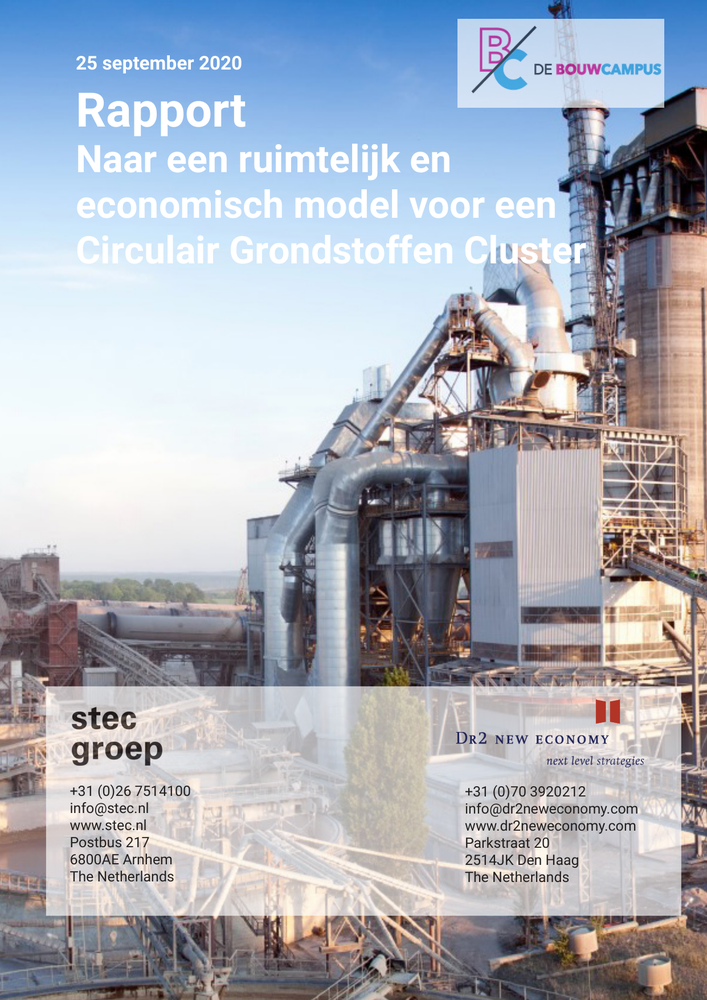
A spatial-economic model for a Circular Materials Cluster in South Holland, focused on concrete, asphalt and waste flows. Developed with Stec Groep for De Bouwcampus and the Verstedelijkingsalliantie Zuid-Holland.
230,000 homes need circular materials and space
By 2040, 230,000 homes must be built in the southern Randstad. At the same time, the Netherlands aims to be fully circular by 2050. Linking the housing challenge to the circular transition can accelerate both. A Circular Materials Cluster combines production, recycling and processing of concrete, asphalt and waste on one site.
The question and context
The Netherlands aims for a fully circular economy by 2050, with an interim target of 50% less primary raw material use by 2030. Construction and industry play a central role: together they account for more than half of Dutch material use and around 60% of energy use.
At the same time, South Holland faces a major housing task. The southern Randstad must realise 230,000 homes by 2040, largely in existing urban transformation areas. That puts pressure on industrial land while also creating demand for circular building materials.
Meeting construction demand through 2040 requires roughly 6 Mt of materials per year for housing and asphalt; more than 80% of that is for concrete and asphalt.
Spatial-economic model
New Economy and Stec Groep developed a first spatial-economic model for De Bouwcampus and the Verstedelijkingsalliantie Zuid-Holland. The model helps assess locations for future production capacity, industrial symbiosis and circular material processing, focusing on concrete, asphalt and waste streams.
The model combines conditions for industrial symbiosis, re- and upcycling of waste streams, renewable energy, lower CO₂ impact and a pathway towards a very low environmental cost indicator.
Three future scenarios
The project explored three increasing levels of ambition. Each scenario builds on the previous one.
| Scenario | Approach | Outcome |
|---|---|---|
| 1. More efficient | Production and design processes remain broadly the same, but become more efficient. | Not enough for climate and circularity targets. |
| 2. Use the urban mine | Partly renewable and sustainably produced resources, partly materials from the urban mine. | Still insufficient to reach 75% circularity by 2040. |
| 3. New production and circular design | New production methods and circular product design. | 75% circularity by 2040 becomes feasible; the cluster is most promising. |
Is a cluster promising?
A Circular Materials Cluster becomes promising when demand-side and public-sector steering push the market towards circular material use and design. Environmental pricing, CO₂ pricing and environmental cost criteria in procurement can make circular production more attractive.
The business case in figures: if the targets are met, the sectors save on average around €13 million (concrete), €11 million (asphalt) and €9 million (waste) in environmental costs each year. Fully utilising the urban mine at high quality lowers the annual environmental cost indicator (ECI) from an average of €75 million to €65 million: a 15% decrease. Scaling up requires 2 Mt of renewable or reusable material per year, worth around €24 million in annual ECI reduction; the third scenario additionally saves around €100 million per year in environmental costs in waste processing.
- Logistical advantages matter, but are not enough on their own.
- Relocation becomes relevant for companies with poor accessibility or growing processing capacity.
- Energy infrastructure and shared sustainable energy can strengthen the case.
- New chain partners can emerge around innovation, applied research and new materials.
Spatial requirements
The cluster requires space suitable for heavier industrial functions, water access, road access and phased growth. The model points to a starting size of 5 to 8 hectares, with possible expansion to 10 to 30 hectares over time.
Phasing strategy
A cluster can start with one or two larger companies from the asphalt or concrete chain, potentially combined with a major energy partner. From there, additional processors, suppliers, innovators and knowledge partners can be added as demand and commitment grow.
Download the report
Frequently asked questions
Insights from this project
Project of De Bouwcampus
The spatial-economic model for the Circular Materials Cluster was developed by New Economy together with Stec Groep, commissioned by De Bouwcampus and the Verstedelijkingsalliantie Zuid-Holland. The project builds on the earlier co-creation project Balans Wonen en Werken by the Verstedelijkingsalliantie and De Bouwcampus.
A Circular Materials Cluster is a location where production, recycling and processing of building materials from the concrete, asphalt and waste sectors are combined, so that material flows are closed, energy is shared and industrial symbiosis emerges.
By 2040, 230,000 homes must be built in the southern Randstad, largely within existing urban areas. That puts pressure on existing industrial sites. Linking the housing task to the circular transition accelerates and strengthens both.
Only the third scenario, with new production methods and circular product design, makes 75% circularity by 2040 feasible. Becoming more efficient or only using the urban mine is not enough on its own.
A starting size of 5 to 8 hectares net, with phased expansion to 10 to 30 hectares and individual plots of 1 to 4 hectares. The location needs road and water access (inland shipping class IV to V) and proximity to energy infrastructure.
New Economy developed the spatial-economic model together with Stec Groep, for De Bouwcampus and the Verstedelijkingsalliantie Zuid-Holland.
Frequently asked questions about the Circular Materials Cluster
Meeting construction demand through 2040 requires, according to this study, roughly 6 Mt of materials per year for housing and asphalt; more than 80% of that is for concrete and asphalt.
If the targets are met, the sectors save, according to this study, on average around €13 million (concrete), €11 million (asphalt) and €9 million (waste) in environmental costs each year.
Fully utilising the urban mine at high quality lowers the annual environmental cost indicator (ECI), according to this study, from an average of €75 million to €65 million: a 15% decrease.
Construction and industry together account, according to this study, for more than 50% of Dutch material use and around 60% of energy use.
The Netherlands aims, according to this study, for a fully circular economy by 2050, with an interim target of 50% less primary raw material use by 2030.
Scaling up requires, according to this study, 2 Mt of renewable or reusable material per year, worth around €24 million in annual ECI reduction.
The third scenario saves, according to this study, around €100 million per year in environmental costs in waste processing.
According to this study, CO₂ pricing and using environmental cost criteria in procurement make circular production more attractive, which strengthens the case for a cluster.
Related reading
Circular construction needs spatial capacity
The circular transition in construction is not only a material challenge. It is also a spatial, logistical and economic challenge: circular flows need locations, infrastructure, demand and coordinated public steering.
Get in touch