
Jaarbeurs towards a climate-neutral food chain
For the UFI Sustainability Award 2022, Jaarbeurs mapped its route towards a greener and climate-neutral food chain. New Economy calculated the CO₂ impact of sustainable hospitality choices: from the menu in its own restaurants to preventing food waste across the whole chain.
846 tonnes of CO₂ saved in a normal year
Jaarbeurs’ sustainable hospitality measures can save up to 846 tonnes of CO₂ in a normal year. Hospitality accounts for around a quarter of annual revenue, with around 2.3 million visitors per year. The ambition: to become the most sustainable venue in Europe and reach a climate-neutral food and beverage chain by 2030.
Download the report (PDF)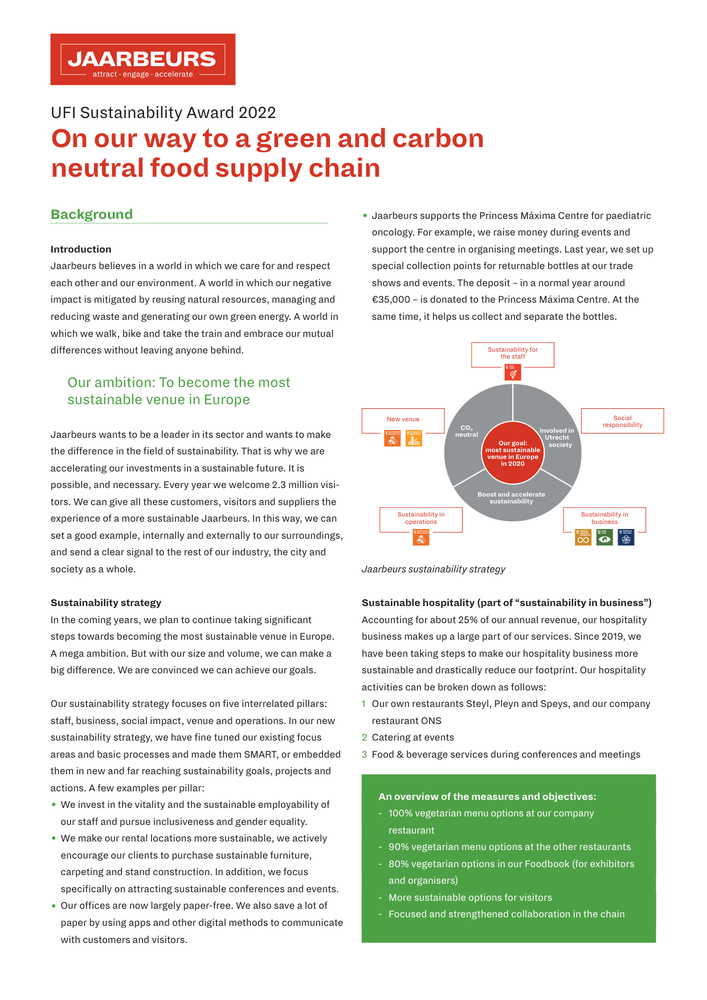
The ambition
Jaarbeurs wants to become the most sustainable venue in Europe and is accelerating its investments in a sustainable future to get there. With around 2.3 million visitors per year, the organisation can make a real difference and send a clear signal to the sector, the city and society. The sustainability strategy rests on five interconnected pillars: employees, business, societal impact, venue and operations.
Hospitality accounts for around a quarter of annual revenue and forms a large part of the service offering. Since 2019, Jaarbeurs has been working to shrink its footprint, across its own restaurants, catering at events, and food and beverage services during congresses and gatherings.
From meat to plant
The logical first step focuses on quick wins. Meat and meat production are globally the third largest source of CO₂, so greening the menu starts with predominantly vegetarian options. The staff restaurant ONS has a fully vegetarian menu, the three Jaarbeurs restaurants are 90% vegetarian, and through the Foodbook that organisers and exhibitors use to arrange their catering, 80% vegetarian options apply.
Greening the chain
Real impact comes not only from looking at your own operations, but at the whole food and beverage chain. New strategic partnerships were formed for this purpose.
- Greendish — a partner for healthier and more sustainable recipes, procurement and menus, with an academy where kitchen teams learn about sustainability.
- Winnow and De Clique — smart waste bins measure what is left over from the kitchen and buffets; De Clique processes this residual stream sustainably. This has prevented more than 100,000 kilograms of waste.
- In-house composting machine — from 2022, this processes kitchen scraps into up to 82,800 kilograms of compost per year. For every kilogram of organic waste composted instead of incinerated, around 0.05 kilograms of CO₂ is saved.
- Too Good To Go and the food bank — leftover fresh food goes to the Utrecht food bank or is sold to visitors and residents of Utrecht through Too Good To Go. Each box saves an average of 2.5 kilograms of CO₂.
- From Utrecht, for everyone — fresh bread, cheese and vegetables come from Utrecht suppliers wherever possible; products sourced from further away carry at least a sustainability label.
The calculated impact
The CO₂ savings build up from 2019 towards a normal year in 2023, when the full programme runs again. 2020 and 2021 had limited opening hours due to the pandemic.
| Measure (kg CO₂) | 2022 | 2023 |
|---|---|---|
| Foodbook and vegetarian offering | 115,777 | 154,106 |
| Too Good To Go | 54,792 | 90,015 |
| Winnow | 134,986 | 221,763 |
| Composting machine and De Clique | 16,240 | 26,680 |
| Food bank | 33,720 | 44,959 |
| Staff restaurant ONS | 16,529 | 22,039 |
| Restaurants Speys, Zeyn and Steyl | 214,876 | 286,501 |
| Total | 586,919 | 846,062 |
846 tonnes in a normal year
In a normal year, the sustainable hospitality measures add up to a saving of around 846 tonnes of CO₂. In addition, 177,916 meals are prevented, 11,500 trees are planted in compensation and 82,800 kilograms of compost are produced. The largest contributions come from the shift to vegetarian in the restaurants, preventing food waste through Winnow, and compensation through Trees for All.
Three lessons
- Dare to act. There are many opportunities within the food and beverage chain. Vegetarian is the obvious choice; a limited transition phase and inspiring communication help bring visitors along, without forcing it.
- Use sustainability for branding. A green hospitality offering strengthens the brand and its appeal, especially among younger generations, and also boosts the employer brand.
- Choose partners deliberately. Do not try to invent everything yourself; seek partners who strengthen, accelerate or improve the initiative.
Method and role
The CO₂ impact was calculated by New Economy, based on data from Jaarbeurs and its suppliers. The 2023 impact assumes a normal year with visitor numbers similar to 2019. Public data from RIVM and publieke bronnen was used where possible; missing data was filled in with expert estimates from New Economy.
Read also the SCBA for Mensa Mensa and the analysis of Voedselcirkel Amsterdam.
How to cite
Jaarbeurs and New Economy (2022). UFI Sustainability Award: towards a green and climate-neutral food chain. Available via neweconomy.eco.
Download the report
- Jaarbeurs UFI Sustainability Award (PDF)The full report with the strategy, the sustainable hospitality measures, the calculated CO₂ impact per year and the lessons learned. Download the report (PDF)
Insights from this project
Frequently asked questions
The report maps the CO₂ impact of Jaarbeurs’ sustainable hospitality, for the UFI Sustainability Award 2022. New Economy calculated the savings from measures that green the food and beverage chain.
In a normal year, the sustainable hospitality measures can save around 846 tonnes of CO₂. The largest contributions come from the shift to vegetarian, preventing food waste through Winnow, and compensation through Trees for All.
Among others, the vegetarian offering in the restaurants and the Foodbook, Too Good To Go, Winnow’s smart waste bins, the composting machine with De Clique, the food bank and tree-planting compensation.
Jaarbeurs wants to become the most sustainable venue in Europe and is aiming for a climate-neutral food and beverage chain by 2030. Hospitality accounts for around a quarter of annual revenue.
The CO₂ impact was calculated by New Economy, based on data from Jaarbeurs and its suppliers, with public data from RIVM and publieke bronnen and expert estimates where data was missing.
Frequently asked questions about the climate-neutral food chain
In a normal year, alongside the CO₂ saving, 177,916 meals are prevented and 11,500 trees are planted in compensation via Trees for All.
In 2021, 286,501 kg of CO₂ was saved by making the menu in the three Jaarbeurs restaurants predominantly vegetarian; of the 390,000 visitors, 85% ordered through the Foodbook.
The staff restaurant ONS is fully vegetarian, the three Jaarbeurs restaurants are 90% vegetarian, and 80% vegetarian options apply through the Foodbook.
With Winnow’s smart waste bins and De Clique, more than 100,000 kg of waste has been prevented; the in-house composting machine processes kitchen scraps into up to 82,800 kg of compost per year.
Each Too Good To Go box saves an average of 2.5 kilograms of CO₂ by keeping leftover fresh food from going to waste.
In 2022 the saving was around 586,919 kg of CO₂, rising to 846,062 kg in a normal year (2023), when the full programme runs again.
Preventing food waste through Winnow is the largest single item at around 221,763 kg of CO₂ in a normal year.
Jaarbeurs receives around 2.3 million visitors per year, and hospitality accounts for around a quarter of annual revenue.
Related reading
CO₂ impact of food and hospitality
From measure to substantiated CO₂ impact. New Economy calculates the footprint and savings of food, hospitality and chain measures, and translates these into strategy and communication.
Plan a conversation