
Almost 70% less CO₂ with a baseline measurement and LCA
Together with New Economy, healthcare concept JOYinCARE mapped the environmental impact of its products and organisation through a baseline measurement and an LCA. With targeted product adjustments, almost 70% CO₂ reduction is possible, without compromising on quality. The insights became the starting point for a broader sustainability strategy.

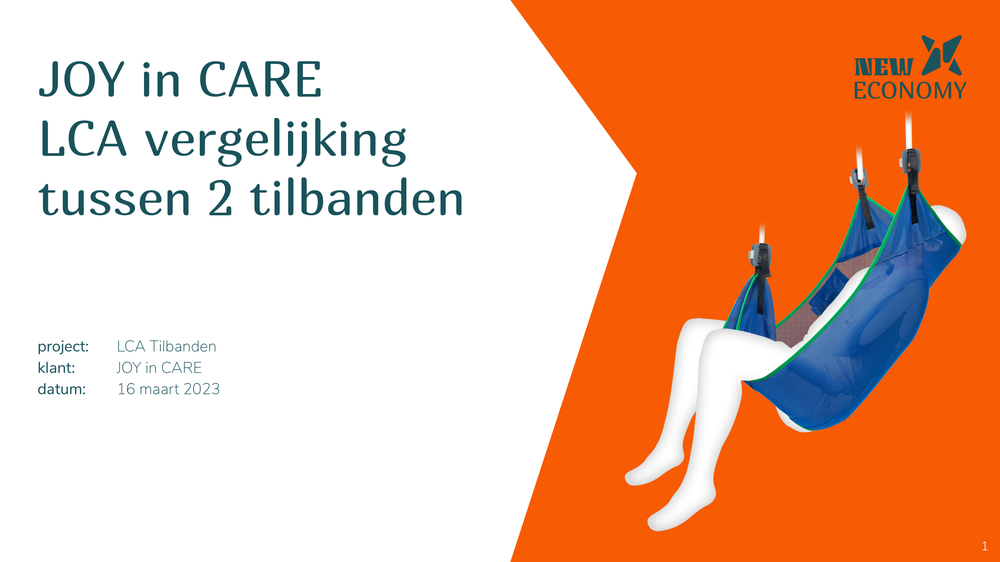
JOYinCARE LCA
The full life-cycle assessment of the transfer slings as a PDF, with the reasoning behind the figures.
Download the deliverable (PDF)About this project
- Prepared by
- New Economy.
- Client and sector
- JOYinCARE, with the Green Care concept — healthcare and textiles.
- The question
- What is the environmental impact of the products, such as the transfer slings, and of the organisation, and where are the biggest opportunities to reduce it?
- The result
- Almost 70% CO₂ reduction possible at product level, plus sustainability embedded in the organisation.
Insights from this project
The qualitative insight cards from the LCA are translated into English and linked to this project page.
In short
With Green Care, JOYinCARE introduces a healthier and more sustainable alternative in the healthcare and textile sector. New Economy mapped the environmental impact of the organisation and its products through a baseline measurement and an LCA, as a starting point for a broader sustainability strategy.
The biggest gain sits in the product. With targeted adjustments to the transfer slings, almost 70% CO₂ reduction is possible, without giving up quality.
The question
What is the real environmental impact of the products, such as the transfer slings, and of the organisation, and where are the biggest opportunities to reduce it? Also with an eye on upcoming regulation such as the CSRD.
The approach
New Economy carried out two analyses: a baseline measurement of the organisation’s CO₂ footprint, and an LCA of the transfer slings, assessing the environmental impact of production, use and processing. Not a tick-box exercise, but a starting point to determine where the impact sits and what should get priority.
The method
The baseline measurement and LCA complement each other: one looks at the organisation, the other at the product across its full life cycle.
| Analysis | Level and focus |
|---|---|
| Baseline measurement | The organisation: the current situation and CO₂ emissions as a baseline. |
| LCA | The product (transfer slings): the environmental impact across the full life cycle. |
Together they provide insight at organisation and product level — exactly what is needed to make substantiated choices.
The result
The key findings are shown as cards above: almost 70% CO₂ reduction possible at product level, a roadmap with clear priorities, and sustainability embedded in every team, from the sewing workshop to product development. Also concrete decision-making based on impact, such as factoring sustainability into the relocation of the warehouse to the production site in Assen, and treating the CSRD as a step-by-step opportunity rather than a burden.
It is great to see how meticulous and deliberate New Economy was with data — a big difference from other consultants. They were critical and warned against unconscious greenwashing, while at the same time being very practical, with directly usable solutions.
JOYinCARERegenerative perspective
For New Economy, a measurement like this is a stepping stone towards regenerative business: from reducing impact to net positive. And the substantiated data helps directly with sustainability reporting and broader strategic choices.
Frequently asked questions
A baseline measurement of the organisation’s CO₂ footprint and an LCA of the transfer slings, as a basis for a broader sustainability strategy.
With targeted product adjustments, almost 70% compared to conventional products, without giving up quality.
The baseline measurement mapped the impact of the whole organisation; the LCA mapped that of a specific product, the transfer slings, across its full life cycle.
The healthcare sector, and the textile industry in which JOYinCARE operates with its products.
The measurement delivers the substantiated data needed for sustainability reporting such as the CSRD and for strategic choices.
Frequently asked questions about the baseline measurement and LCA
In this project, a baseline measurement mapped the CO₂ footprint of the organisation as a baseline: the current situation and emissions, a starting point to determine where the impact sits and what should get priority.
An LCA (life-cycle assessment) evaluates a product’s environmental impact across its full life cycle. In this project the baseline measurement looked at the organisation and the LCA at the transfer slings, from production and use to processing.
To gain insight at both organisation and product level: together they show where the impact sits and which choices deserve priority.
Because the substantiated data from the baseline measurement and LCA is directly usable for sustainability reporting; in this project the CSRD becomes a step-by-step opportunity rather than an obligation.
In this project, impact was weighed in concrete decisions, such as factoring sustainability into the relocation of the warehouse to the production site in Assen.
For New Economy, a measurement like this is a stepping stone towards regenerative business: from reducing impact to net positive.
Among other things an LCA of the transfer slings as a PDF, a roadmap with clear priorities, and sustainability embedded in every team.
In every team, from the sewing workshop to product development.
Related reading
Less CO₂ with substantiated data
From baseline measurement and LCA to targeted choices and a substantiated sustainability strategy. See also Baseline measurement / footprint.
Plan a conversation