
De Plaetse (Zuid) indicative social cost-benefit analysis
An indicative social cost-benefit analysis of the plans for De Plaetse (Zuid) on the site of De Kleine Aarde in Boxtel: a knowledge and practice centre for regenerative agriculture. The analysis maps the economic, socio-cultural and nature-driven benefits.
Around €17 million in societal benefits per year
An initial investment of €3.5 million in De Plaetse (Zuid) delivers around €17 million in societal benefits per year. Those benefits arise across economic, social and cultural, and nature dimensions, with around €14.5 million benefiting the Boxtel region and around €5 million benefiting the Netherlands as a whole.
Download the report (PDF)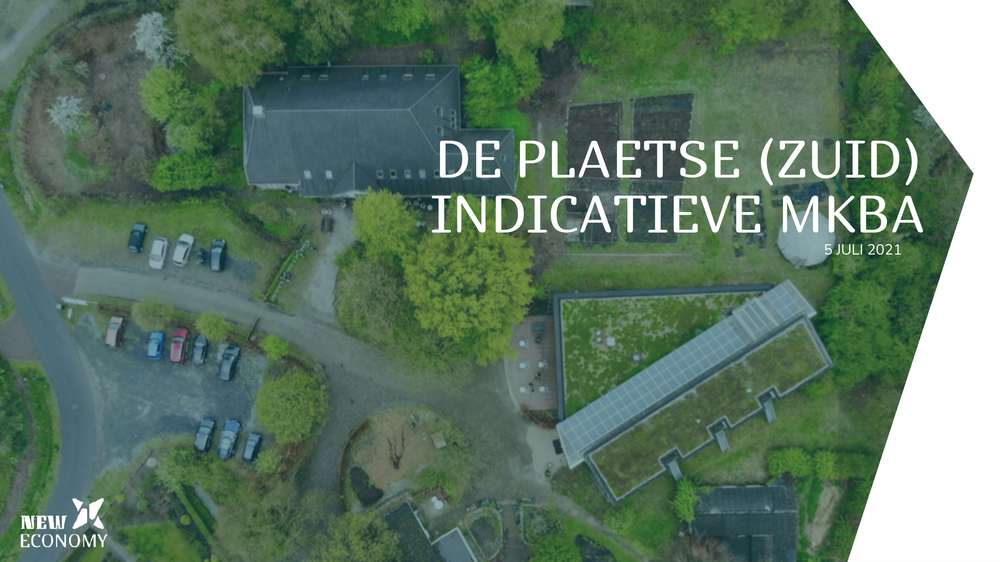
De Kleine Aarde and De Plaetse (Zuid)
The site of De Kleine Aarde started in 1972 as a centre for pioneering in regenerative agriculture. In 2013 the site came into the municipality’s books, and a search began for a new purpose. De Plaetse (Zuid) developed a ten-year plan in which De Kleine Aarde grows into a sustainable meeting place, with educational projects around regenerative agriculture and lively events, attractive to visit, also for the neighbourhood.
In July 2021 the new plans were presented to the municipality of Boxtel. They include an initial investment of €3.5 million to restore the existing buildings, develop a programme for 350 farmers per year and make the site attractive for recreation, relaxation and meeting. To map the impact of the plans, the board asked New Economy for an indicative social cost-benefit analysis.
What the SCBA offers
An SCBA is a decision-support instrument that maps the full societal impact of a spatial plan across sectors, for government, business and citizens. Both short and long-term benefits are expressed in a financial value, so that choices become possible that create the most value for the living environment.
The analysis compares a zero alternative, in which no plans are carried out, with a project alternative, in which the measures are carried out. For the project alternative, three things were mapped: the measures from the plan, the resulting change in quality, and the benefits, determined by multiplying the number of beneficiaries by the price of the benefit.
The zero alternative
In the zero alternative, no plans are carried out and the site remains in use as it currently is. The municipality then has very limited resources to maintain the site, insufficient to restore the buildings. The current initiatives lack an autonomous structure and legal basis, which makes them vulnerable. Over time the buildings deteriorate, the value of the cultural heritage declines and De Kleine Aarde ceases to be an attractive place to visit. That lowers quality of life in the surrounding area and the value of nearby homes, without knowledge about regenerative agriculture being developed or visitors being drawn to the region.
The value of regenerative agriculture
Many companies depend on ecosystem services for their survival, and the agricultural sector in particular: farming relies on soil fertility, water availability and pollination. DNB and PBL mapped that Dutch financial institutions have €510 billion in financing outstanding to companies with a high dependence on these services. The World Bank calculated that economic damage from nature loss will rise to 2.7 trillion dollars per year by 2030.
Regenerative agriculture contributes strongly to restoring ecosystem services, with long-term returns in the form of fertile soil that stores CO₂, retains water and sustains insects and ecosystems. Research shows that carbon storage in soil under regenerative methods is two to four times higher than under conventional agriculture, up to around 3,075 kilograms of CO₂ per hectare per year. Direct investments in restoring biodiversity, soil and nature are therefore also needed from an economic perspective.
Three types of benefits
The societal costs and benefits of De Kleine Aarde are worked out in three components.
| Type of benefit | Indicative value | Main source |
|---|---|---|
| Economic benefits | ±€11 million | recreation, local food production, reinvestment and training for 350 farmers per year |
| Social and cultural benefits | ±€5.5 million | mainly indirect, through a 1.6% value increase for 850 surrounding homes due to greening, plus events and employment |
| Nature-driven benefits | ±€0.52 million | investments in the experimental farm, teaching materials and the restoration of land and nature |
Value for whom
The values reinforce each other in a positive feedback loop, with impact across multiple generations.
- For city residents — an attractive place for easy relaxation, learning, working, meeting and enjoying healthy, local food.
- For agricultural entrepreneurs — an alternative to scaling up, through proximity to hospitality, education, care and retail.
- For the neighbourhood — a better physical and social living environment.
- For the Netherlands and globally — knowledge about restoring ecosystem services through regenerative agriculture.
Around €17 million per year
The total societal benefits across economy, social and nature amount to around €17 million per year through the arrival of De Plaetse (Zuid). The main measures are the quality boost to the site and the renovation of the buildings, the annual training for farmers, the increase in local employment, the preservation of the cultural-historical function and the development of an experimental farm. Around €14.5 million is directly attributable to the Boxtel region, around €5 million to the Netherlands. The added societal value for the region, the municipality of Boxtel and the Netherlands is therefore very high, through both direct and indirect impact on employment, living environment, biodiversity and CO₂ emission reduction.
Method and team
The indicative SCBA compares a zero alternative with a project alternative and values the quality change and benefits per measure. The valuation builds on the methodology of WUR and Witteveen+Bos (2013), adapted by New Economy, and on sources including CBS, PBL, publieke bronnen, DNB and the World Bank.
The analysis was carried out by Jonah Link, Iris Grobben and Pepijn Duijvestein. Read also the SCBA for Mensa Mensa and the analysis of Voedselcirkel Amsterdam.
How to cite
New Economy (2021). De Plaetse (Zuid): indicative SCBA. Available via neweconomy.eco.
Download the report
- Indicative SCBA De Plaetse (Zuid) (PDF)The full report with the context, method, the three types of benefits and the conclusion on the societal value of the plan. Download the report (PDF)
Insights from this project
Frequently asked questions
De Plaetse (Zuid) is a ten-year plan for the site of De Kleine Aarde in Boxtel, growing into a knowledge and practice centre for regenerative agriculture with educational projects, recreation and events.
The indicative SCBA amounts to around €17 million in societal benefits per year, from an initial investment of €3.5 million. Around €14.5 million benefits the Boxtel region and around €5 million the Netherlands.
Economic benefits of around €11 million, social and cultural benefits of around €5.5 million and nature-driven benefits of around €0.52 million, together around €17 million.
Regenerative agriculture restores ecosystem services such as fertile soil that stores CO₂ and retains water. Soil carbon storage is two to four times higher than under conventional agriculture, up to around 3,075 kilograms of CO₂ per hectare per year.
The board of De Plaetse (Zuid) asked New Economy for the analysis, to map the impact of the plans ahead of presenting them to the municipality of Boxtel in 2021.
Frequently asked questions about the indicative SCBA for De Plaetse
DNB and PBL mapped that Dutch financial institutions have €510 billion in financing outstanding to companies with a high dependence on ecosystem services.
The World Bank calculated that economic damage from nature loss will rise to 2.7 trillion dollars per year by 2030.
These benefits are mainly indirect, arising among other things from a 1.6% value increase for 850 surrounding homes due to greening, plus events and employment.
The initial investment of €3.5 million includes a programme to train 350 farmers in regenerative agriculture each year.
Without the plans, the buildings deteriorate, the value of the cultural heritage declines and De Kleine Aarde ceases to be attractive, lowering the living environment and the value of nearby homes.
For city residents (relaxation, learning, local food), agricultural entrepreneurs (an alternative to scaling up), the neighbourhood (a better living environment) and the Netherlands and globally (knowledge about restoring ecosystem services).
The site started in 1972 as a centre for pioneering regenerative agriculture; in 2013 it entered the municipality’s books, after which De Plaetse (Zuid) developed a ten-year plan.
The analysis was carried out by Jonah Link, Iris Grobben and Pepijn Duijvestein, building on the methodology of WUR and Witteveen+Bos (2013), adapted by New Economy.
Related reading
Societal value of a plan or area
From plan to substantiated societal value. New Economy produces indicative and full SCBAs for area development, food and regenerative agriculture, and translates benefits into concrete choices.
Plan a conversation