
From measurable baseline to regenerative impact
New Economy solutions are practical routes from measurable baseline to regenerative impact. The approach connects impact measurement, strategy, product design and regional implementation. For businesses, products, municipalities and provinces, each route starts with evidence: CO2 footprint, eco-costs, life-cycle assessment (LCA), social cost-benefit analysis (MKBA) and implementation logic. The result is a concrete path from data to choices, designs, business models and programmes that add value for ecosystems and society.
Eight routes from analysis to action
Each card points to a concrete service or solution page.
CO2 footprint and environmental costs as a measurable starting point for decisions.
Open page →Impact data translated into measurable targets, priorities and an executable action plan.
Open page →Social cost-benefit analysis (MKBA) to substantiate broader value beyond direct financial return.
Open page →Life-cycle assessment (LCA) and product footprint insight across materials, production, use and end-of-life.
Open page →Product and concept development that moves from lower damage towards restoration and added value.
Open page →Economic and ecological potential of resources, materials and circular business models, supported by calculation tools.
Open page →Strategy and vision development for municipalities and regions working on sustainable transition pathways.
Open page →Food strategy, healthy living environments and social value for area-based transition work.
Open page →A single logic across different questions
The common thread is simple: measure the current situation, identify material effects, translate insight into design and strategy, and build a route that can be implemented. This applies to company footprints, product development, circular value chains, food systems, climate plans and regional programmes.
Evidence comes first. That can mean a CO2 footprint, eco-cost analysis, life-cycle assessment (LCA), material assessment, social cost-benefit analysis (MKBA), climate opportunity scan or practical workshop format.
Projects and insights
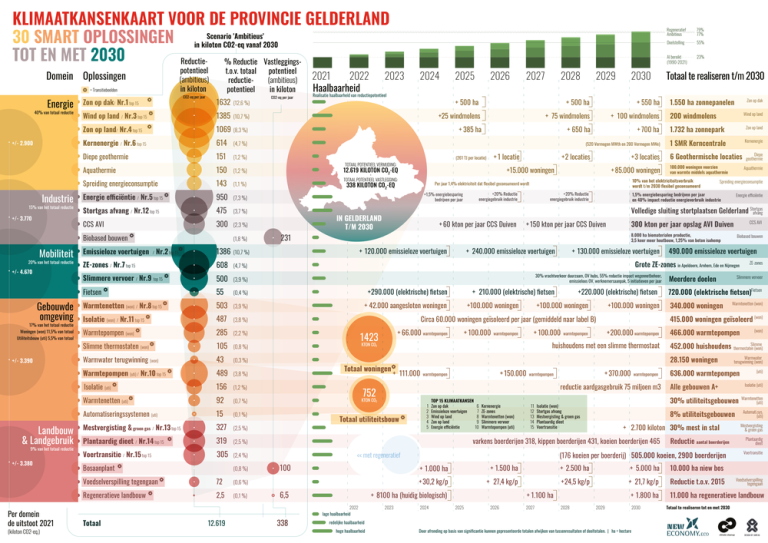
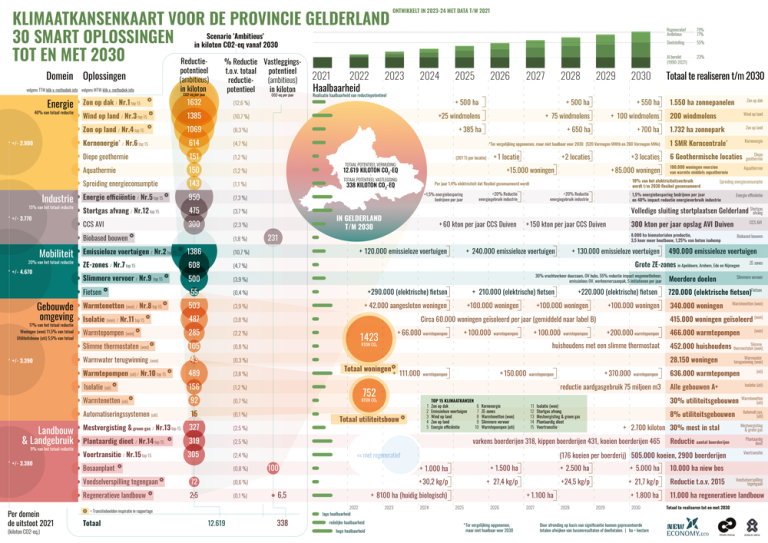
Recent work and published insights show how solution routes become concrete in products, organisations and regions.
Recent work
Projects for businesses, products and regions, often with a pioneering character.
All projects →
Insights
Figures, lessons and recommendations from applied work.
Frequently asked questions
A New Economy solution is a practical route from measurable baseline to regenerative impact, combining CO₂ footprint, eco-costs, life-cycle assessment (LCA), social cost-benefit analysis (MKBA), design choices and implementation logic.
The solution routes support businesses, product teams, municipalities, provinces and regional partnerships working on climate, circular economy, food systems, carbon sequestration, biobased materials or circular business models.
Most routes start with a baseline measurement, footprint, life-cycle assessment (LCA), eco-cost analysis or social cost-benefit analysis (MKBA), followed by strategy, design and implementation.
Regenerative work goes beyond lower damage. The aim is measurable restoration and added value for ecosystems and communities, including CO₂ reduction, carbon sequestration, healthier material choices and social value.
Ready for a measurable next step?
A first step often starts with one concrete question, a baseline measurement or a focused impact scan.
Start a conversation