
Quick Scan: Circular Bicycles
RVO (the Netherlands Enterprise Agency) asked New Economy to carry out a quick scan into the potential for circularity in the bicycle sector. The analysis explores opportunities for greater circularity and stimulation options in light of the National Transition Agenda for Consumer Goods.
From sales volume to lifespan
The quick scan shows that circularity in the bicycle sector mainly calls for extending lifespan, better repairability, parts availability and standardisation between brands and systems.
The desired direction is not simply more recycling, but above all value retention: using bicycles for longer, keeping parts available for longer, and redeploying high-value frames and components.
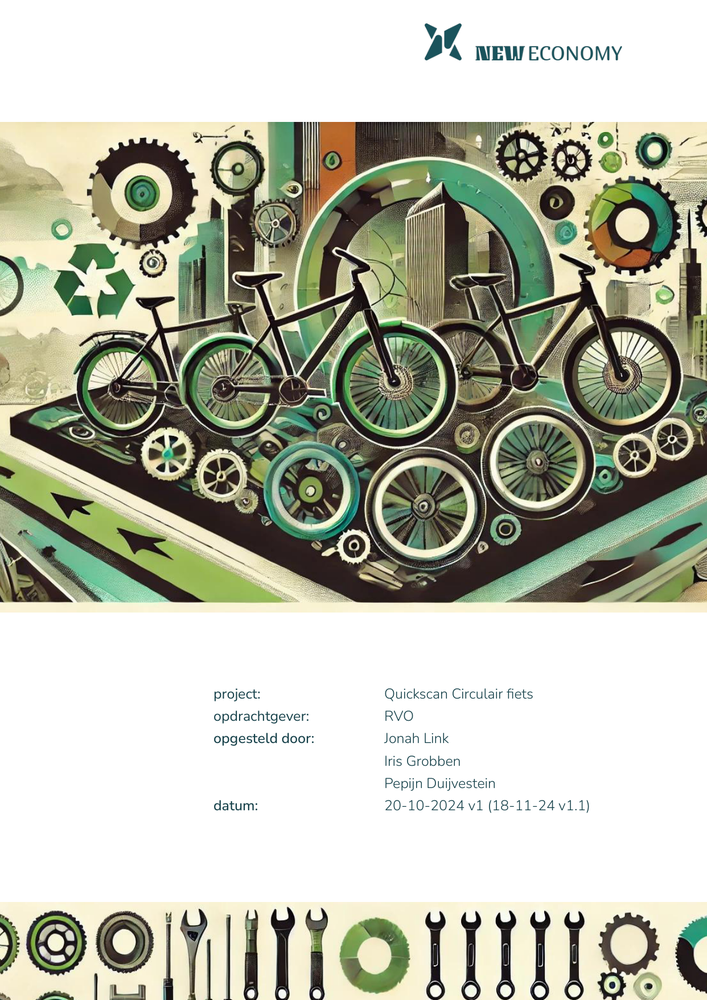
About this project
Prepared by: New Economy, commissioned by RVO.
The question: what is the potential for circularity in the bicycle sector, and which stimulation options fit that potential, in light of the National Transition Agenda for Consumer Goods.
Core finding: circularity in the bicycle sector mainly calls for extending lifespan, better repairability, parts availability and standardisation, and more conscious material choices.
The result: insight into circularity opportunities, the material trade-off around electric bicycles, and policy directions such as repairability as a design requirement and inclusion in ESPR.
In short
The quick scan examines the potential for circularity in the Dutch bicycle sector. The existing bicycle fleet numbers more than 22.9 million bicycles and represents 400,000 to 500,000 tonnes of material: a substantial material stock in society, not just a mobility solution.
More than 85% of Dutch people own at least one bicycle. In 2022, 57% of bicycles sold in the Netherlands were e-bikes: the highest share in Europe.
The common thread is a shift from sales volume to lifespan. Greater circularity comes mainly from longer use, better repairability, parts availability and standardisation, supplemented by more conscious material choices for both traditional and electric bicycles.
Not selling more bicycles, but keeping bicycles on the road longer. The greatest gains lie in extending lifespan and retaining value, not in higher sales volume.
Extending lifespan as the main task
The quick scan notes that the average lifespan of bicycles is under pressure. The desired direction is to extend that lifespan, with an average lifespan of 15 years as a possible product-performance target.
| Theme | According to the quick scan |
|---|---|
| Pressure on lifespan | Lower quality, higher parts costs, supply-chain disruptions, limited standardisation and more complex electric components. |
| Desired direction | Extending lifespan, more repair and refurbishment, and a possible product-performance target of 15 years average lifespan. |
15 years. Extending the average lifespan as a possible product-performance target, with repair and refurbishment at its core: maintenance and parts availability central, and redeploying high-value frames and components.
Better parts and more standardisation
The quick scan states that frames, components and spare parts should be standardised much more. That makes parts more readily available, cheaper and easier to replace, and is one of the key conditions for a circular bicycle.
| Topic | Direction from the quick scan |
|---|---|
| Spare parts | More readily available, cheaper and easier to replace. |
| Standardisation | Standardise frames, components and spare parts much more between brands. |
| Parts lifespan | Ideally remain available for at least 10 to 15 years. |
Better parts and better interchangeability keep a bicycle in use longer, make maintenance more attractive than replacement, raise second-hand value and strengthen the refurbishment chain.
Four conditions stand out: parts should ideally remain available for 10 to 15 years; standardisation between brands and systems should increase; wheels, chains and components should be easier to remove and replace; and right to repair, open solutions and clear spare-parts structures should support repairability.
The right materials, not simply an e-bike
The quick scan makes clear that material choice matters, and that the electric bicycle is not automatically the best choice. Critical materials, battery impact and a shorter lifespan call for a more conscious trade-off.
| Variant | Relative environmental impact |
|---|---|
| Steel city bike | Reference (lowest impact). |
| Aluminium city bike | Higher than steel due to material choice. |
| Aluminium e-bike | Roughly 15x higher than a steel city bike. |
| Steel electric bicycle | Roughly 17% lower than the aluminium variant. |
| E-bike with recycled aluminium | Roughly 18% lower than with primary aluminium. |
First the right bicycle, then the right materials. The traditional bicycle can once again more strongly serve as the standard; electric assistance makes most sense for physical limitations or longer distances.
| Insight | From the quick scan |
|---|---|
| Material choice | Steel and recycled material lower impact; critical materials deserve extra attention. |
| E-bike impact | The battery and electricity use together account for roughly a third of an aluminium e-bike’s impact over five years. |
| E-bike use | The traditional bicycle should again become more the standard; an e-bike mainly for physical limitations or longer distances. |
Insights and policy direction
The analysis translates the bicycle sector into concrete entry points for circularity and policy.
| Insight | Meaning for circularity |
|---|---|
| 22.9 million bicycles in the Netherlands | The existing bicycle fleet represents a substantial material stock in society. |
| 400,000 to 500,000 tonnes of material in bicycles | The bicycle sector is relevant as a material flow, not only as a mobility solution. |
| Repairability determines lifespan | Higher parts costs, chain disruptions and limited standardisation put repairability under pressure. |
| Electric bicycles require more material | Battery, motor and critical materials make the material trade-off more important. |
| Design requirements provide direction | Repairability as a design requirement and inclusion in ESPR for the bicycle product group are relevant measures. |
| Growing sector 2015–2022 | The sector grew by 3,495 companies (+13%) and 13,800 FTE (+30%); production value rose by 79% to €3.24 billion in 2022. |
Include repairability as a design requirement, keep spare parts available for longer, stimulate standardisation, and explore inclusion in ESPR for the bicycle product group.
Frequently asked questions
Insights from this project
Quick Scan Circular Bicycles for RVO
New Economy carried out the Quick Scan Circular Bicycles for RVO. The analysis connects circularity in the bicycle sector to lifespan extension, repairability, parts availability, standardisation and material choices.
The quick scan investigates the potential for circularity in the bicycle sector and explores opportunities for greater circularity and stimulation options in light of the National Transition Agenda for Consumer Goods.
The quick scan notes that the average lifespan of bicycles is under pressure. Extending lifespan, repair, refurbishment and better parts availability keep bicycles on the road longer and retain more value than early replacement.
No. The quick scan makes clear that material choice matters and that the electric bicycle is not automatically the best choice. Critical materials, battery impact and a shorter lifespan call for a conscious trade-off.
The quick scan mentions repairability as a design requirement, inclusion in ESPR, parts availability, standardisation and keeping spare parts available for longer as relevant directions.
Frequently asked questions about circular bicycles
The Netherlands has around 22.9 million bicycles; more than 85% of people own at least one bike.
The bicycle stock represents an estimated 400,000 to 500,000 tonnes of material, according to this quick scan.
The estimated annual impact is 0.24 to 0.39 Mt CO₂-eq, according to this quick scan.
A steel electric bicycle has roughly 17% lower impact and an e-bike with recycled aluminium roughly 18% lower.
In 2022, 57% of bicycles sold were e-bikes, the highest share in Europe.
Around 800,000 new bicycles were sold in the Netherlands in 2023.
Parts typically remain available for 10 to 15 years, which supports lifespan extension.
For an aluminium e-bike, the battery and electricity use together account for roughly a third of the impact over a five-year lifespan.
Further reading
From quick scan to circular design choices
The quick scan makes visible where the greatest opportunities lie: longer lifespan, better repairability, smarter material choices and more standardisation.
Plan a discovery call View Product Footprint