
CO₂ · Shared mobility · Reduction
Ride-Check CO₂-eq reduction management
CO₂-eq reduction management is the systematic measurement, explanation and reduction of greenhouse gas emissions. For Ride-Check (Check Technologies B.V.), a Dutch shared mobility provider, New Economy mapped the climate impact of the company’s activities for reference year 2022. The analysis follows the Greenhouse Gas Protocol and connects to the Dutch CO₂ Performance Ladder. The baseline distinguishes direct emissions, purchased energy and value-chain emissions. This produces insight into the total CO₂-eq impact, the main emission sources and a reduction pathway towards 2030. For shared mobility, the combination of fleet development, electricity use, vehicle production and transport is decisive. The report therefore steers not only on absolute emissions, but also on emissions per passenger-kilometre.
Nederlandstalige projectpagina
Project page
Baseline for reduction steering
Ride-Check asked New Economy to carry out a baseline measurement and to map reduction opportunities. The report provides an overview of approach, method, results and reduction management, in line with the Greenhouse Gas Protocol and the CO₂ Performance Ladder.
Download report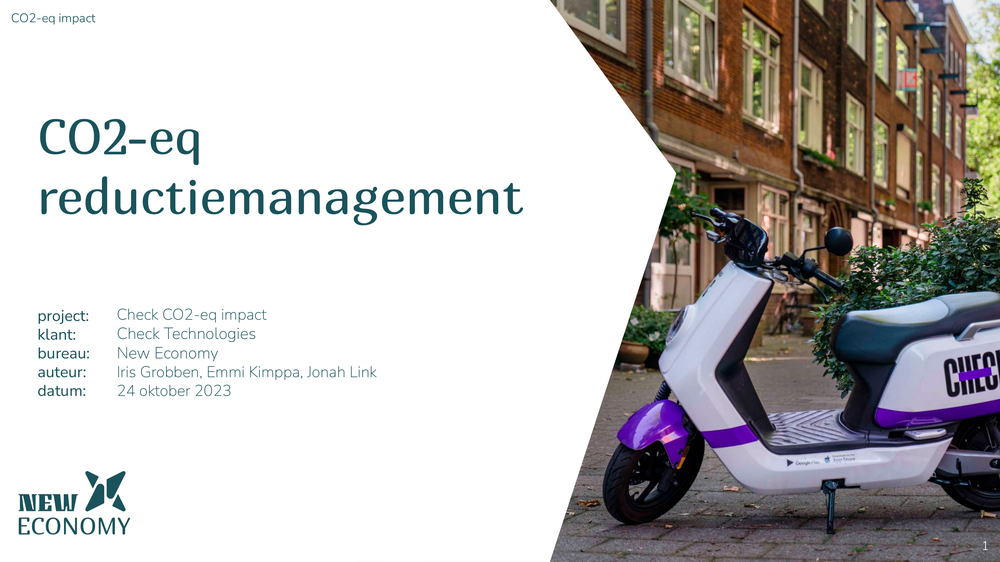
Question and context
Ride-Check is a player in the Dutch shared mobility market with a mission to provide mobility solutions that replace car trips and improve the liveability of cities. Stakeholders, including municipalities and users, increasingly ask for insight into the sustainability of operations, CO₂ reduction management and compensation.
For Ride-Check it was strategically relevant to have a clear picture of the current CO₂ impact and reduction opportunities. The analysis was carried out for reference year 2022 and forms a basis for insight, reduction targets, CO₂ policy, structural communication and participation.
Method Greenhouse Gas Protocol
The baseline measurement uses the Greenhouse Gas Protocol, a globally applied framework for measuring the greenhouse gas emissions of private and public organisations. The analysis covered collection, calculation and evaluation of the greenhouse gas emissions of Ride-Check.
| Scope | Meaning | Application in analysis |
|---|---|---|
| Scope 1 | Direct emissions from sources owned by the organisation. | Direct emissions within the operational boundaries. |
| Scope 2 | Indirect emissions from the use of purchased energy. | Electricity use of charging containers, hubs and office. |
| Scope 3 | Indirect emissions from sources in the value chain. | Purchased goods, capital goods, transport, waste, commuting and business travel. |
The steps followed were: defining system boundaries, collecting data, determining impact for scope 1, scope 2 and scope 3, validating the impacts through an audit by SpaakCS, setting targets, making a plan to reach them and reporting.
Baseline results 2022
In reference year 2022 the emissions of Ride-Check total 3,645 t CO₂-eq. Scope 3 determines the overall picture, partly due to investments in fleet expansion in 2022.
| Scope | Emissions 2022 | Interpretation |
|---|---|---|
| Scope 1 | 2,736 kg CO₂-eq | Direct emissions. |
| Scope 2 | 165,539 kg CO₂-eq | Mainly electricity use of charging containers. |
| Scope 3 | 3,477,690 kg CO₂-eq | Mainly purchasing of mopeds, kickscooters and parts and transport of goods. |
KPI per passenger-kilometre
Per passenger-kilometre the total emission is 28 g CO₂-eq in 2022. This covers all emissions in scope 1, scope 2 and scope 3. Logistics and maintenance cover operational emissions such as waste, commuting and business travel. Moped production also includes the emissions for the production of parts and transport of mopeds to the Netherlands.
The KPI was calculated over 26,686,934 passenger-kilometres in reference year 2022.
Because of large fluctuations in scope 3, it is more appropriate to set targets per passenger-kilometre. For Ride-Check the sectoral decarbonisation approach per passenger-kilometre fits, because it is sector-specific, supports comparability and allows monitoring during fleet development.
Measures for reduction
The reduction approach consists of measures for scope 2 and scope 3. Scope 2 focuses on green electricity and energy efficiency. Scope 3 focuses on lifespan extension of parts, sustainable procurement, transport optimisation and emission-free commuting and business travel.
| Measure | Scope | Direction | Reduction potential |
|---|---|---|---|
| Green electricity | Scope 2 | Switch to renewable energy at facilities. | 4.8 g CO₂-eq/pkm |
| Energy-efficient use | Scope 2 | Lower consumption per kilometre and encourage more efficient riding. | — |
| Lifespan extension of parts | Scope 3 | Focus on battery pack, aluminium and motor, together responsible for 72% of production impact. | 2.5 g CO₂-eq/pkm |
| Sustainable procurement | Scope 3 | Request LCA or EPD, select suppliers on climate performance and apply an internal CO₂ price. | 2.5 g CO₂-eq/pkm |
| Transport optimisation | Scope 3 | Avoid rush deliveries by air freight and improve inventory management. | 1.1 g CO₂-eq/pkm |
| More passengers per trip | Scope 3 | Increase the average number of passengers per trip from 1.3 to 1.4. | 2.4 g CO₂-eq/pkm |
| Emission-free commuting and business travel | Scope 3 | Encourage employees to use emission-free transport. | 0.8 g CO₂-eq/pkm |
The report notes that switching to renewable energy at all facilities delivers a 5% reduction on total emissions in 2022. For transport, avoiding air freight delivers around 63% reduction in the impact of transporting parts from China.
In 2021, 30% of the fleet consisted of second-hand mopeds and 15% of the batteries were second-hand. Since the start in 2019, not a single moped has been written off through use.
Together the measures lead to a reduction of 14.1 g CO₂-eq per passenger-kilometre in 2030. Emissions thus fall from 28 g CO₂-eq in 2022 to around 14 g CO₂-eq per passenger-kilometre, a halving relative to the reference year.
Communication and participation
In the context of transparency towards stakeholders, Ride-Check can present a clear ambition. This can be done by publishing insights from the baseline, the targets set and CO₂ reduction plans on the website. This supports transparency, accountability, stakeholder information, engagement, risk management, reputation and dialogue.
The final element of successful CO₂ reduction management is participation in impact-reducing initiatives. The report mentions mobility tables of provinces and municipalities, last-mile solutions for delivery, grid congestion as part of the solution and research participation.
Accountability and audit
The baseline measurement was carried out for Ride-Check (Check Technologies B.V.) by New Economy. The analysis was developed with Ride-Check’s own data, sector data, Idemat 2023, CO₂ emission factors and scientific literature. The authors are Emmi Kimppa, Jonah Link and Iris Grobben.
An audit and third-party validation took place, carried out by SpaakCS. This was an external, independent assessment of approach, methodology, data and results. SpaakCS reviewed the method and results used and found them sound.
Download the report
Insights
Key insights from the baseline
Frequently asked questions
CO₂-eq reduction management for Ride-Check is a baseline measurement and reduction approach for the climate impact of the company’s activities, prepared in line with the Greenhouse Gas Protocol and complemented with targets, KPIs, measures, communication and participation.
The baseline was carried out with the Greenhouse Gas Protocol. The analysis covers scope 1, scope 2 and relevant scope 3 emissions and uses Ride-Check’s own data, sector data, Idemat, CO₂ emission factors and scientific literature.
In reference year 2022 the emissions of Ride-Check totalled 3,645 t CO₂-eq. The split was 2,736 kg CO₂-eq in scope 1, 165,539 kg CO₂-eq in scope 2 and 3,477,690 kg CO₂-eq in scope 3.
Scope 3 emissions can fluctuate strongly due to fleet expansion and investments. A KPI per passenger-kilometre makes reduction measurable per mobility service delivered and fits the sectoral decarbonisation approach.
The reduction target for 2030 is 50% fewer emissions per passenger-kilometre relative to 2022. That means a reduction from 28 g CO₂-eq per passenger-kilometre in 2022 to 14 g CO₂-eq in 2030.
Frequently asked questions about CO₂-eq reduction management
According to this baseline, scope 1 was 2,736 kg CO₂-eq, scope 2 165,539 kg and scope 3 3,477,690 kg CO₂-eq.
Production and air freight of parts fall under scope 3 and together account for 87% of all emissions.
The baseline is based on 26,686,934 passenger-kilometres in 2022.
Green electricity delivers the largest reduction, 4.8 g CO₂-eq per passenger-kilometre, around 5% of total emissions in 2022.
Avoiding air freight for parts from China can cut emissions by around 63%.
Lifespan extension of parts saves 2.5 g CO₂-eq per passenger-kilometre; the battery pack, aluminium and motor together make up 72% of production impact.
In 2021, 30% of the fleet consisted of second-hand mopeds and 15% of the batteries were second-hand; since the start in 2019, not a single moped has been written off.
More passengers per trip, from an average of 1.3 to 1.4, saves 2.4 g CO₂-eq per passenger-kilometre.
From baseline to reduction pathway
New Economy translates climate data into practical reduction steering: scopes, KPIs, measures, governance and communication.
Get in touch