
Handbook for a circular business park
A practical roadmap for entrepreneurs, municipalities and park management to make business parks circular, future-proof and executable.
From ambition to roadmap
The handbook translates circular economy into a roadmap approach for business park practice. The approach helps determine urgency, select promising interventions, organise ownership and formalise implementation.
Download the handbook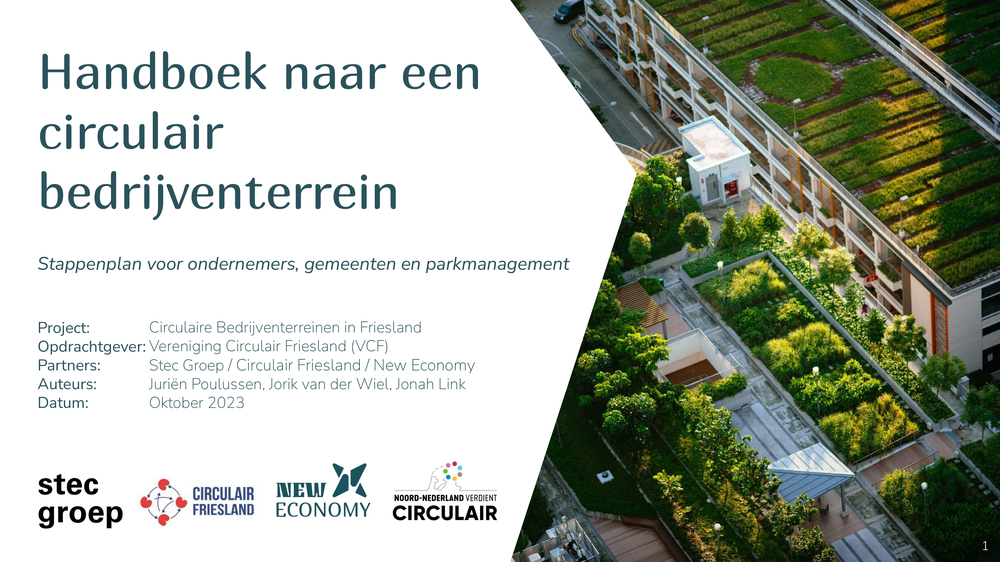
Why this handbook?
Business parks are places where material flows, energy use, logistics, real estate, water management, employment and entrepreneurship converge. That is precisely why circular potential is high, but implementation requires an approach that fits many companies, owners and public interests.
The roadmap approach makes the step from ambition to implementation concrete. First, urgencies and opportunities are made visible. Then interventions are worked out. Finally, roles, conditions, planning and agreements are formalised.
The roadmap in three steps
1 Identify and prioritise
Determine where the urgency lies and which themes are most relevant for entrepreneurs, the municipality and park management.
2 Concretise
Translate opportunities into executable interventions with a clear goal, involved parties, required resources and conditions.
3 Formalise
Record agreements on ownership, financing, planning, consultation structure and follow-up.
Seven pillars for integrated work
| Pillar | Focus |
|---|---|
| Materials | raw materials, residual streams and circular procurement |
| Energy | saving, generation, storage and smart grid use |
| Water | retention, infiltration, saving and reuse |
| Biodiversity | greenery, soil quality and ecological connections |
| Society | collaboration, organisational capacity and local value |
| Health | a healthy, safe and attractive working environment |
| Value | economic, societal and ecological benefits |
Eight insights from the handbook
- A circular business park starts with urgency.
- The 7 pillars make circularity integrated.
- Roadmaps only work with buy-in.
- Start with a maximum of three short-term actions.
- Park management can accelerate progress.
- A baseline measurement makes priorities discussable.
- Interventions require ownership and conditions.
- Success breeds success.
Download the handbook
From park to transition practice
The roadmap approach makes circularity executable at business parks: concrete enough for entrepreneurs, manageable for municipalities and organisable for park management.
Insights from this project
Frequently asked questions about a circular business park
A business park is where material flows, energy use, logistics, real estate, water management, employment and entrepreneurship converge. That is precisely why circular potential is high. According to this handbook, implementation requires an approach that fits many companies, owners and public interests.
According to this handbook, with a roadmap approach that makes the step from ambition to implementation concrete. The approach helps determine urgency, select promising interventions, organise ownership and formalise implementation.
First you identify and prioritise: determine where the urgency lies and which themes are most relevant. Then you concretise opportunities into executable interventions with a goal, involved parties, resources and conditions. Finally you formalise agreements on ownership, financing, planning and follow-up.
Materials (raw materials, residual streams and circular procurement), energy (saving, generation, storage and smart grid use), water, biodiversity, society, health and value. Together the seven pillars ensure circularity is tackled in an integrated way rather than as separate projects.
According to this handbook, a circular business park starts with urgency. A baseline measurement makes priorities discussable, and it is best to start with a maximum of three short-term actions. That keeps the approach manageable and lets success build on success.
Roadmaps only work with buy-in, and park management can accelerate implementation. Interventions also require clear ownership and the right conditions, otherwise they are left on the shelf.
Among others: a circular business park starts with urgency, the seven pillars make circularity integrated, roadmaps only work with buy-in, start with a maximum of three short-term actions, park management can accelerate progress, a baseline measurement makes priorities discussable, interventions require ownership, and success breeds success.
The handbook is intended for entrepreneurs, municipalities and park management. It was prepared for Vereniging Circulair Friesland (2023), with New Economy providing roadmap guidance, together with the partners Stec Groep, Circulair Friesland and Noord-Nederland verdient Circulair.