
Concepts, methods and applied transition knowledge
The New Economy knowledge base brings together core concepts, methods and perspectives from the regenerative economy. Articles explain footprint, compliance, circular product design, regenerative strategy, food systems and regional policy in practical terms, with clear links to life-cycle assessment (LCA), social cost-benefit analysis (MKBA), CO2 footprint, carbon sequestration, biobased materials and circular business models.
Carbon sequestration
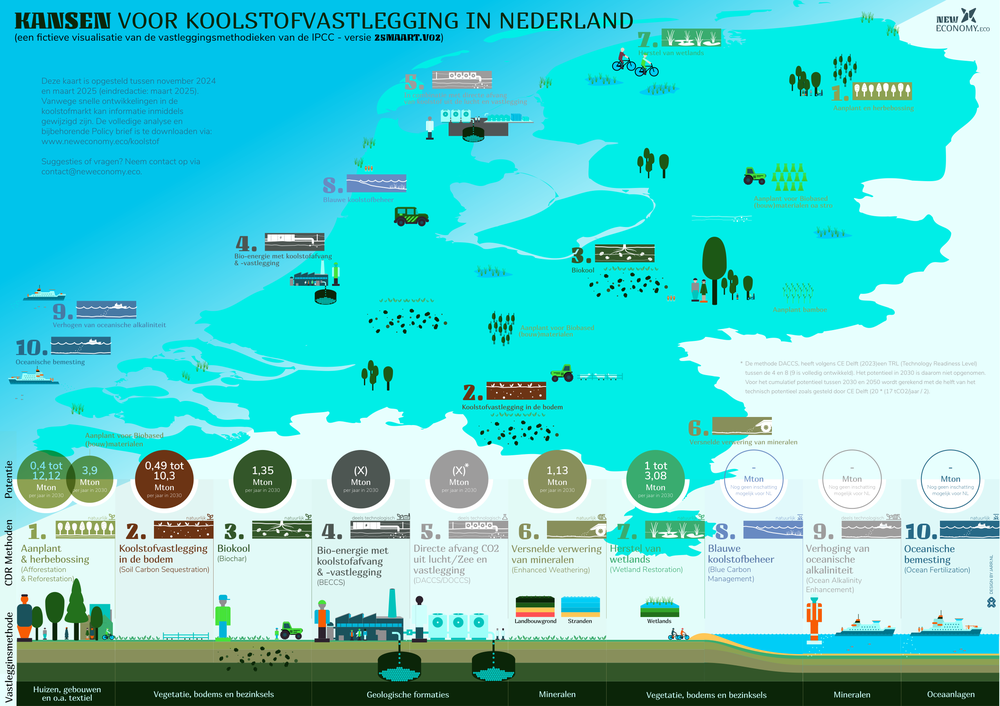
Carbon sequestration is the removal of CO₂ from the atmosphere and its storage in soil, biomass, nature, water, long-lived materials or geological storage.
The climate value depends on the quantity, duration and certainty of storage, and the extent to which sequestration is combined with emission reduction.
Applied in practice
New Economy quantifies carbon sequestration for provinces and regions using the Drawdown methodology, combined with a Pareto analysis of the largest emission sources. Natural sequestration (soil, forest, biobased construction) is considered alongside technological options such as CCS, CCU and BECCS.
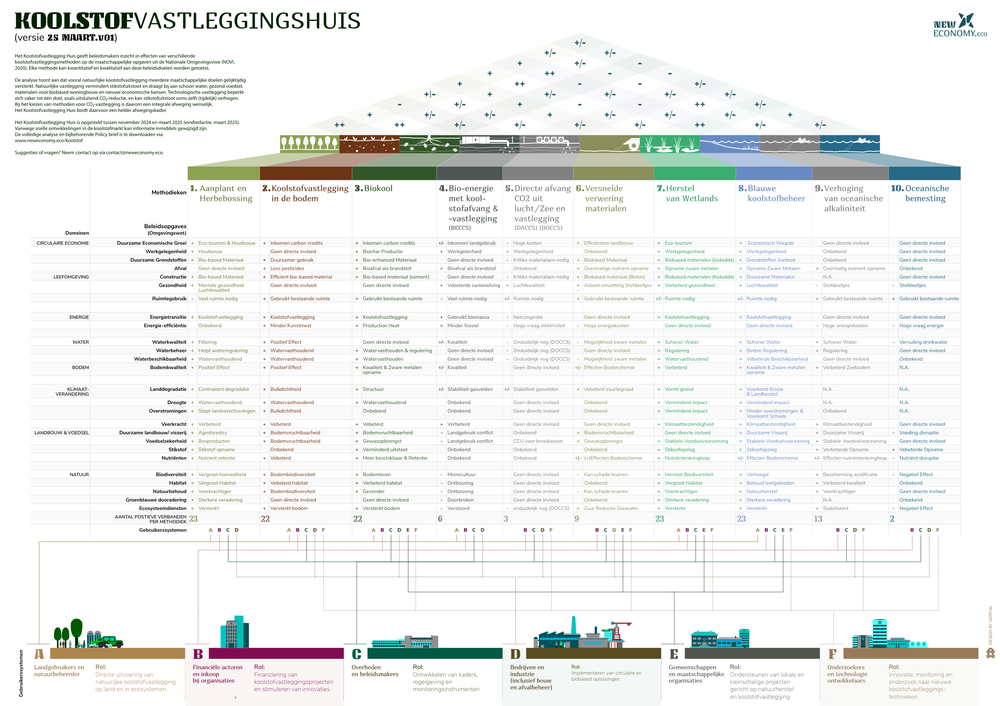
Link with policy objectives. The link differs strongly per method: natural sequestration scores 22 to 23 of the 26 objectives in the Carbon Sequestration House, technological sequestration 3 to 6.
Related terms
The Carbon Sequestration House
The Carbon Sequestration House maps which sequestration methods are linked to the societal objectives of the Dutch National Environmental Vision (NOVI). Each method is assessed against policy goals for the circular economy, living environment, energy, water, soil, climate, agriculture and nature.
The analysis shows that natural sequestration in particular is linked to several objectives at once: lower nitrogen emissions, cleaner water, healthy food, biobased building materials and new economic opportunities. Technological sequestration more often targets a single goal, such as CO₂ reduction alone, and can temporarily raise nitrogen emissions. An integrated trade-off between green and grey methods is therefore preferable.
Links per method. Natural sequestration is linked to 22 to 23 of the 26 societal objectives of the National Environmental Vision; technological methods to 3 to 6.

All terms, searchable
Search the register or browse by letter. Each article opens with the definition, followed by how it works, why it matters and how New Economy applies it, with related terms and source projects.