
Concepts, methods and applied transition knowledge
The New Economy knowledge base brings together core concepts, methods and perspectives from the regenerative economy. Articles explain footprint, compliance, circular product design, regenerative strategy, food systems and regional policy in practical terms, with clear links to life-cycle assessment (LCA), social cost-benefit analysis (MKBA), CO2 footprint, carbon sequestration, biobased materials and circular business models.
CCS and CCU
CCS stands for carbon capture and storage: capturing and storing CO₂. CCU stands for carbon capture and utilization: capturing CO₂ and using it as a raw material in products or processes.
Both technologies capture CO₂ at the source (industry, power generation) before it reaches the atmosphere; CCS stores it geologically, CCU converts it into usable raw materials.
Applied in practice
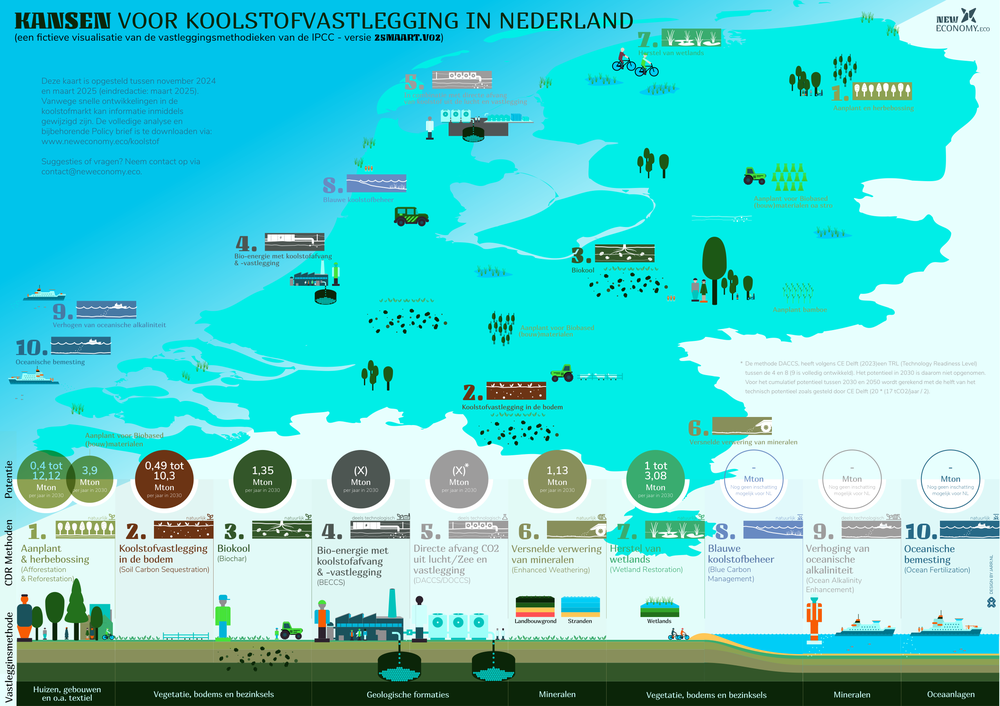
New Economy positions CCS and CCU as technological (grey) options alongside natural carbon sequestration in market studies and regional climate action plans. Both capture CO₂ at the source and can reduce process emissions in industry, but are still costly, energy-intensive and dependent on suitable geological storage. Some projects are linked to Enhanced Oil Recovery, which reduces the climate benefit. Unlike natural methods, CCS and CCU offer no direct benefits for biodiversity, water or soil.
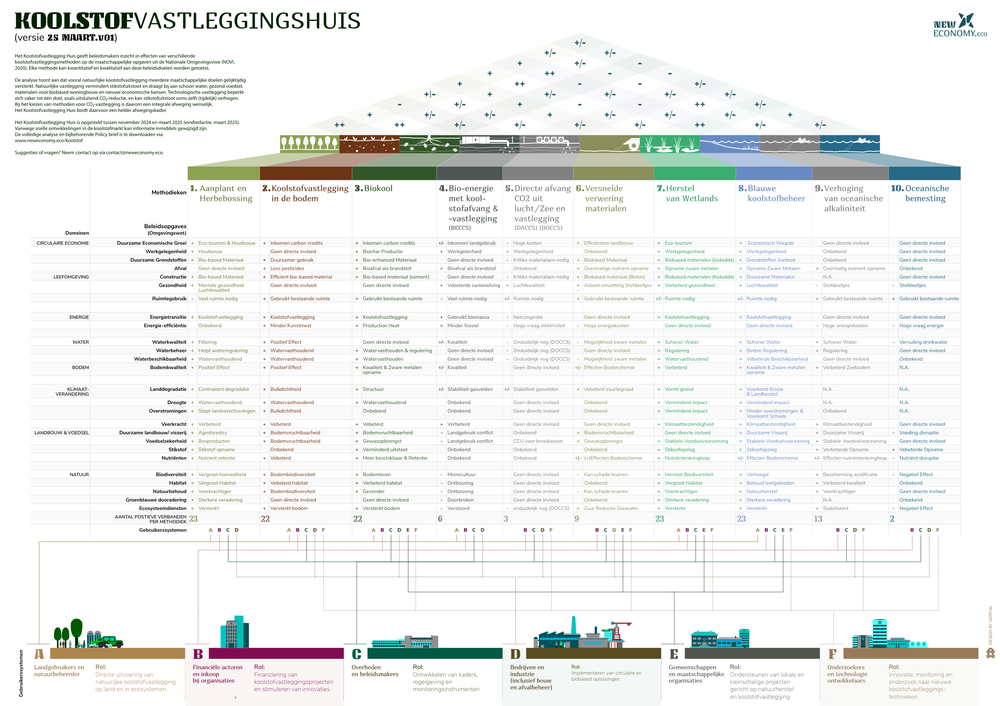
Links per method. Technological capture and storage mainly targets CO₂ reduction. The technological direct-capture route (DACCS/DOCCS) is linked to 3 of the 26 objectives in the Carbon Sequestration House, compared with 22 to 23 for natural methods.
Related terms
The Carbon Sequestration House
The Carbon Sequestration House maps which sequestration methods are linked to the societal objectives of the Dutch National Environmental Vision (NOVI). Each method is assessed against policy goals for the circular economy, living environment, energy, water, soil, climate, agriculture and nature.
The analysis shows that natural sequestration in particular is linked to several objectives at once: lower nitrogen emissions, cleaner water, healthy food, biobased building materials and new economic opportunities. Technological sequestration more often targets a single goal, such as CO₂ reduction alone, and can temporarily raise nitrogen emissions. An integrated trade-off between green and grey methods is therefore preferable.
Links per method. Natural sequestration is linked to 22 to 23 of the 26 societal objectives of the National Environmental Vision; technological methods to 3 to 6.

All terms, searchable
Search the register or browse by letter. Each article opens with the definition, followed by how it works, why it matters and how New Economy applies it, with related terms and source projects.