
Three food studies and the social value of Amsterdam’s food initiatives
On 30 June 2026, New Economy presented three of its own studies on the social value of food initiatives at the “Onderzoek dat Voedt!” knowledge session hosted by the City of Amsterdam: the social cost-benefit analysis (MKBA) for Amsterdam-Noord, the impact assessment of Mensa Mensa, and the report on Voedselcirkel Amsterdam as a food hub. The session took place on the Day of the Food Transition, as part of Amsterdam’s food strategy.
Amsterdam’s food strategy
The City of Amsterdam is working towards a healthy, fair, sustainable and affordable local food system. The food strategy’s implementation agenda focuses on six action lines to realise and scale up concrete projects, including support for existing initiatives such as the food circle in Amsterdam-Noord. The “Onderzoek dat Voedt!” knowledge session brought research and practice together on the Day of the Food Transition.
Amsterdam food strategy (Open Research Amsterdam) · Amsterdam food strategy (amsterdam.nl)
From informal food aid to preventive infrastructure
Surplus & waste
Food surplus and overproduction: edible food goes to waste while shelves stay full.
Insecurity & stress
Families cannot afford healthy meals; scarcity exists alongside abundance.
A commercial food system
Designed for volume and margin, not for nutrition or fairness — the market does not close this gap on its own.
Social food outcomes
Food initiatives fill the gap: they rescue food and help people who need it.
Not a poverty problem, but a misdistributed food system. The MKBA takes that premise as its starting point: (informal) food initiatives are not a temporary emergency fix, but a structural link.
Three studies, three angles
The three studies were carried out independently, but share the MKBA (social cost-benefit) methodology and the same subject: the social value of food initiatives in Amsterdam.
MKBA food initiatives Amsterdam-Noord
Client: City of Amsterdam · November 2025. A social cost-benefit analysis of 32 food initiatives — distribution points, social restaurants, connection points, urban farms and a food hub — generating an estimated €15 million in social value per year against €1.7 million in total costs.
Mensa Mensa impact assessment
Client: Ministry of Agriculture, Fisheries, Food Security and Nature · August 2025 – March 2026. Social value of healthy, affordable neighbourhood kitchens: an estimated €0.70 million net value per year per location, a benefit-cost ratio of 3.2.
Food hubs and the strength of Voedselcirkel Amsterdam
Clients: Voedselcirkel Amsterdam & City of Amsterdam · February – June 2026. Voedselcirkel Amsterdam as an urban food hub: an estimated €822,516 in social value per year, 245.6 tonnes of food processed in 2025.
The cost of doing nothing
Without the 32 food initiatives in Amsterdam-Noord, annual social costs would rise to an estimated €45–55 million: roughly €5,500 per person for around 16,000 people.
These costs arise because the commercial food system is designed for volume and margin rather than nutrition or fairness — and because part of the resulting social burden lands with initiatives instead of mainstream provisions.
What 32 initiatives already achieve
The 32 food initiatives already function as social infrastructure: 13 distribution points, 13 social restaurants, 2 connection points, 3 urban farming locations and 1 food hub.
Together, these five infrastructure types generate the estimated €15 million in social value per year. What the MKBA counts within that:
A small public contribution, a large preventive return
The municipal contribution of €0.92 million per year (roughly 6% of the value realised) leverages into €1.70 million in total annual costs and €15 million in social value per year — an estimated €11–16 in social value per municipal euro, and €3 to €30 in social value per public euro depending on the intervention.
| Investment level | Effect |
|---|---|
| €1.3–1.7 mln (current effort) | Already generates around €15 mln in value per year |
| €100,000–200,000 per year | Enough to maintain the existing infrastructure |
| €3–4 mln per year | Investment to scale the network 2× to 4× |
Recognition is the first intervention
The MKBA sets out five steps to anchor informal food initiatives as social infrastructure:
- Recognise — name food initiatives as social infrastructure, not charity.
- Stabilise — provide structural funding, space and operational baseline security.
- Coordinate — invest in governance, data, shared logistics and monitoring.
- Scale — build coverage through packages combining direct aid and supporting infrastructure.
- Monitor & adjust — ongoing monitoring, participation and FIES-based learning.
Structural anchoring further requires four building blocks: recognition & anchoring (as collectively supported social infrastructure, with structural funding, housing and logistical support), coordinated investment (conditions such as kitchen space and a shared facilities cooperative combined with scaling and institutional anchoring), governance & collaboration (a food coordinator and network coordinator to prevent fragmentation) and monitoring & participation (the Food Insecurity Experience Scale and resident involvement to break down cultural and language barriers).
At full scale-up to the remaining 80% of the potential reach, an estimated €30–40 million in additional costs could be avoided.
The calculation model is publicly available
The calculation model behind the MKBA was built specifically for this study in two modules — one for current value (based on fieldwork and 23 interviews), one for scenarios covering 14 interventions — and is free to use in Google Sheets or Excel. A separate tab lists every source and formula. Dozens of food initiatives are already using their own copy of the model.
Open the food initiative calculator
| Core parameter | Value |
|---|---|
| Price per kg of food rescued | €5.56 |
| Value per QALY (health gain) | €50,000 |
| Financial security per household/week/year | €2,790 |
| Climate value per tonne of CO₂ | €250 |
| Activation value per volunteer/year | €3,500 |
Mensa Mensa: the social value of a healthy neighbourhood meal
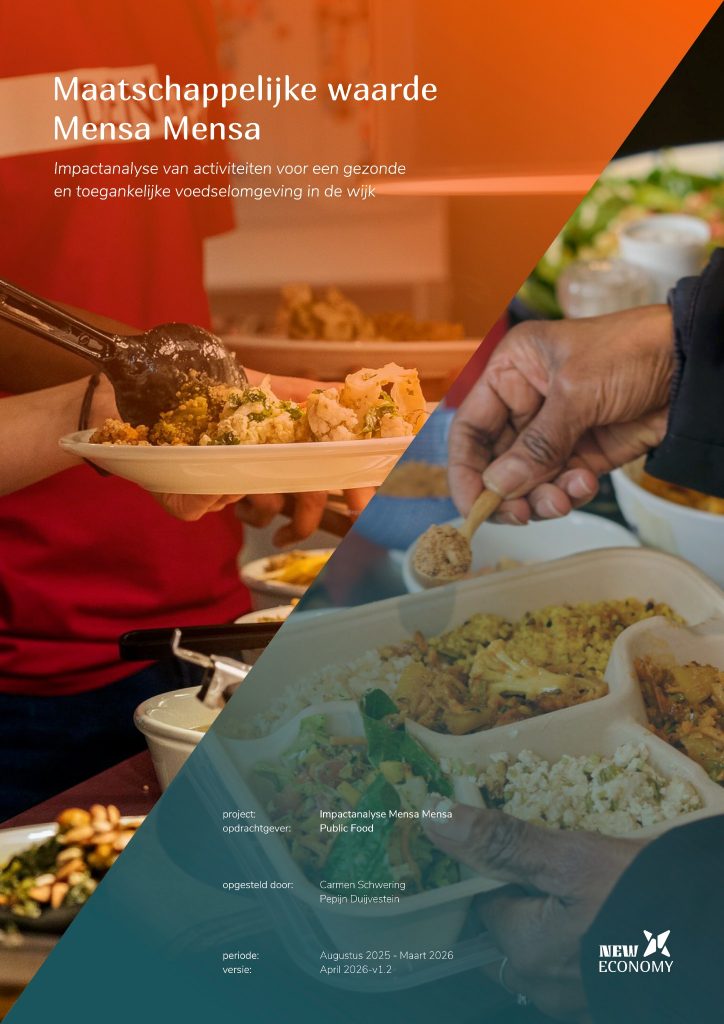
Mensa Mensa (Public Food) combines access, routine, food skills and social embedding into a working neighbourhood model. A modelled standard location delivers an estimated €0.70 million net social value per year, a benefit-cost ratio of 3.2.
The fair price of our food
Beyond the till receipt, a shadow price captures the health and environmental damage of a meal. The average Dutch diet costs an estimated €3.04 per person per day in external damage — €0.57 health and €2.47 environment — roughly €1,110 per person per year, or €4,440 for a household of four.
€0.57 health + €2.47 environment = €3.04 per person per day
The Mensa Mensa meal scores favourably here: roughly on par with the Dutch “Wheel of Five” dietary guideline, and well below fast food and ultra-processed food.
Shadow price per meal (565 g). Consumer price: Mensa Mensa meal €5.00, ultra-processed €3.74, fast food €11.83.
The food environment shapes what Amsterdammers eat
| Mechanism | What it means |
|---|---|
| Price, supply, marketing | The food environment — price, availability, spatial distribution, marketing and information — largely determines what people eat. |
| “Food swamp” | Neighbourhoods with far more unhealthy than healthy food on offer; lower-income areas tend to have more fast-food outlets nearby. |
| Price as a lever | “Unhealthy” is not automatically “cheap”: fast food and convenience meals often cost more than a healthy neighbourhood meal. |
| A vicious circle | Less cooking experience increases reliance on convenience food, which further discourages food skills — especially among lower incomes. |
Building up and phasing out at the same time
The shift towards a healthy food environment runs through an old practice phasing out and a new practice building up, across five scenarios: (1) cooking together and building food skills, (2) an environment that makes healthy eating easier, (3) Mensa Mensa as a neighbourhood model, (4) Mensa Mensa as an open model, and (5) healthy food as a basic provision. The transition tends to stall on the build-up side: phasing out unsustainable practices and connecting scattered initiatives lags behind.
What does the baseline scenario cost — and how much of that is health?
Three calculation lenses set out the social costs of the baseline scenario (no intervention) side by side, each attributing a different share to health.
| Lens | Total per person/year | Of which health | 1,000 low-income residents in a neighbourhood |
|---|---|---|---|
| BASE-1 · cost approach (broad, top-down) | €1,647–1,650 | €333 | €1.61–3.03 mln |
| BASE-2 · QALY welfare loss (scenario) | €155–310 | €155–310 (included) | €5–10 mln |
| BASE-3 · shadow price per meal | €1,110 | €207 | €1.17–1.48 mln |
Source: Mensa Mensa impact assessment v1.2, chapter 3 and table 3.9. The health component alone ranges from roughly €207 to €333 per person per year; total social costs per person per year are higher still.
Voedselcirkel Amsterdam as an urban food hub
Voedselcirkel Amsterdam connects food surpluses, logistics and neighbourhood initiatives. The value of a food hub lies not in the kilos, but in the coordination: gathering surpluses, matching them to demand, safeguarding quality and redistributing them purposefully.
How much prevention funding actually goes to food?
Beyond the three New Economy studies, the knowledge session raised a broader question. Food-related healthcare spending ranges — depending on the framing used — from roughly €1.6 to €10.4 billion per year (RIVM/VTV 2018, RIVM/VZinfo 2022). The share that comes back as prevention funding is small under almost every reading: roughly 0.30% to 1.94% of attributed healthcare spending, compared with 5.10% for physical activity. That points to less direct funding for préventing the consequences of poor diet than for some other lifestyle themes. The full comparison — including physical activity, alcohol and smoking, and figures for both 2015 and 2022 — is set out in a separate article.
Tools and downloads



Frequently asked questions
The MKBA food initiatives Amsterdam-Noord, the Mensa Mensa impact assessment, and the report on Voedselcirkel Amsterdam as a food hub — all three carried out by New Economy.
An estimated €15 million in social value per year against €1.7 million in total costs, of which over €0.92 million is a municipal contribution — a leverage of roughly €11–16 per municipal euro and €3 to €30 per public euro, depending on the intervention.
The Mensa Mensa meal has a social shadow price of €0.46 per meal, roughly on par with the Wheel of Five and well below fast food (€2.83) and red meat (€3.26). The average Dutch diet costs an estimated €3.04 per person per day in external damage.
An estimated €822,516 per year (2025) as an urban food hub, with 245.6 tonnes of food processed and an average partner rating of 8.5 (NPS +46).
Food-related healthcare spending runs up to €10.4 billion per year in the broad RIVM/VZinfo reading, while prevention funding for food stays between roughly 0.30% and 1.94% of that spending under almost every reading — compared with 5.10% for physical activity. The full comparison with physical activity, alcohol and smoking is set out in the article Prevention in numbers.
Related
The underlying reports are available under the Creative Commons Attribution 4.0 licence (CC BY 4.0).
MKBA or impact assessment for food policy
New Economy translates the social value of food initiatives, food policy and food strategy into euros, for municipalities, regions and national government.
Plan a conversation