
Park om de Hoek 2.0 | Neighbourhood green space and co-creation
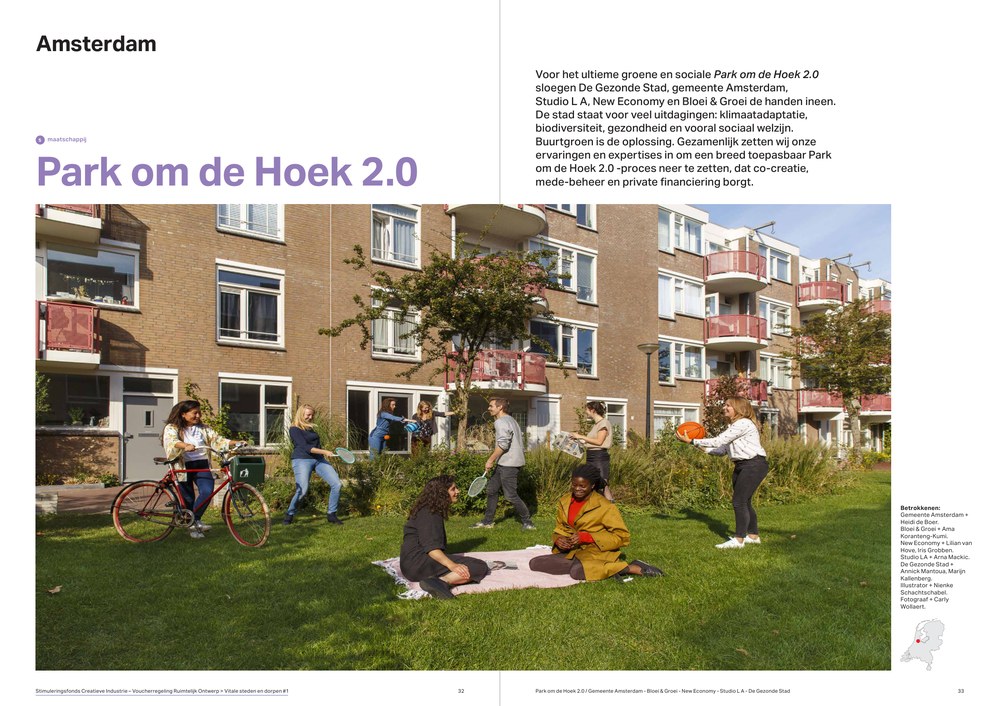
Park om de Hoek 2.0 explores how a small green place close to home can become social infrastructure: a place for meeting, cooling, biodiversity, local ownership and cooperation.
The challenge: green space that works socially and ecologically
The project does not offer one standard design for every park. It provides a process that helps neighbourhoods explore what a local green meeting place needs: who uses it, who maintains it, how it is financed and how it contributes to climate adaptation, biodiversity and health.
New Economy contributed to the financing strategy, business model and process design.
Download the report Download the step-by-step guide Download the budgeting model
Core research question
How can neighbourhood green space be developed as a shared place for ecological quality, social connection, local stewardship and long-term financial continuity?
From one-size-fits-all to process design
A neighbourhood park only works when design, use, stewardship, financing and ownership are aligned. The toolkit helps initiators, community organisations and municipalities address these questions early, before the design becomes fixed.
The toolkit: dialogue, design, budgeting and stewardship
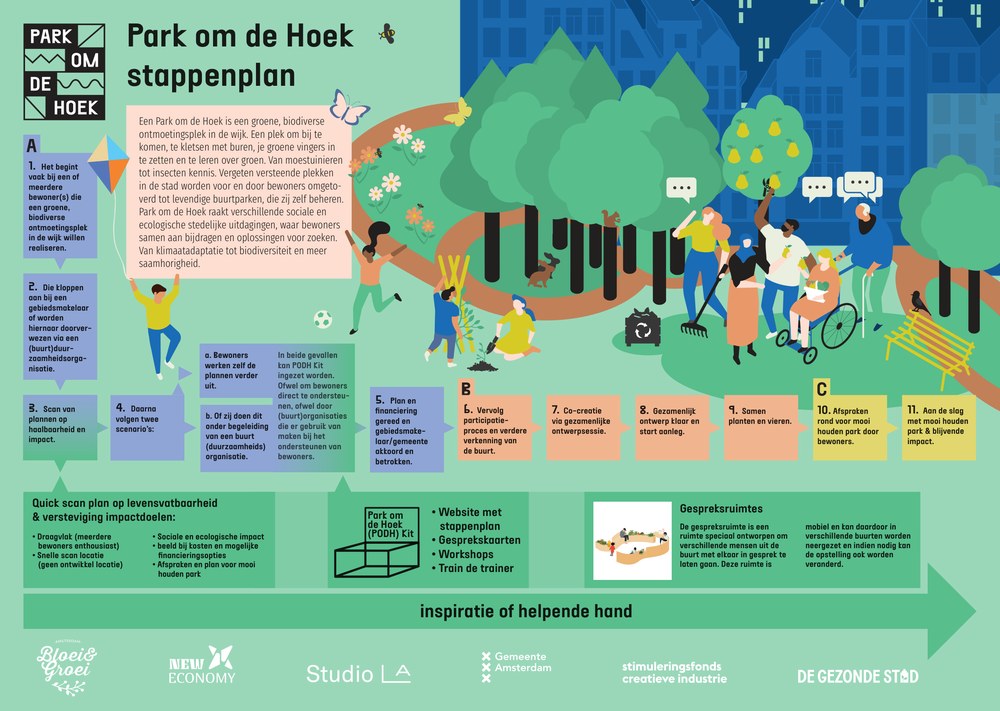
The step-by-step guide shows a visual route for developing a Park om de Hoek, including conversations about local needs, roles, financing, co-creation, design, agreements and long-term stewardship.
New Economy’s role
New Economy worked on the financial and organisational side of the approach: the financing strategy, possible business models, operating budget and process logic that helps turn neighbourhood green space into a durable shared asset.
Operating budget and Excel model
The Excel budgeting model helps make investments, annual costs, stewardship costs and possible contributions transparent. It is meant as a practical conversation tool for initiators, community partners and policymakers.
Six lessons from Park om de Hoek 2.0
- Neighbourhood green space works best when it is treated as social infrastructure.
- Co-creation requires clear roles, not only open conversations.
- Stewardship and maintenance need to be designed from the start.
- Financial continuity is part of the design challenge.
- A visual step-by-step process helps different actors collaborate.
- Small green places can connect climate adaptation, biodiversity and community ownership.
Consortium and collaboration
The project was developed with partners including De Gezonde Stad, the City of Amsterdam, Bloei & Groei, Studio L A and New Economy, within the context of the Spatial Design Voucher Scheme.
Next steps: pilots, policy innovation and empowerment
The next step is to use the toolkit in concrete neighbourhood pilots, refine the operating budget with real local data and connect the approach to policy instruments for climate-adaptive and community-led public space.
Downloads
Insights from this project
Frequently asked questions
Park om de Hoek is an approach for neighbourhood green space in which residents, community organisations, green coaches and municipalities work together on green, biodiverse meeting places close to home.
A neighbourhood park only works when design, use, stewardship, financing and ownership are aligned. Process design helps address these questions early and adapt the approach to each location.
The guide shows a visual route for developing a Park om de Hoek, including conversations about local needs, roles, financing, co-creation, design, agreements and long-term stewardship.
The operating budget helps initiators, community organisations and policymakers explore costs, stewardship, contributions and financial continuity for neighbourhood green space.
Frequently asked questions about Park om de Hoek 2.0
According to this approach Park om de Hoek 2.0 was developed with De Gezonde Stad, the City of Amsterdam, Bloei & Groei, Studio L A and New Economy, within the Spatial Design Voucher Scheme.
According to this approach New Economy worked on the financial and organisational side: the financing strategy, possible business models, operating budget and process logic.
According to this approach the Excel budgeting model makes investments, annual costs, stewardship costs and possible contributions transparent, as a practical conversation tool.
According to this approach Park om de Hoek 2.0 offers six lessons, including that neighbourhood green space works best as social infrastructure and that financial continuity is part of the design challenge.
According to this approach the core question is how neighbourhood green space can be developed as a shared place for ecological quality, social connection, local stewardship and long-term financial continuity.
According to this approach Park om de Hoek 2.0 does not offer one standard design for every park, but a process that helps neighbourhoods explore what a local green meeting place needs.
According to this approach small green places can connect climate adaptation, biodiversity and community ownership.
According to this approach the next step is to use the toolkit in concrete neighbourhood pilots, refine the operating budget with local data and connect the approach to policy instruments for climate-adaptive and community-led public space.