
Two foundations and eight courses of action for carbon sequestration policy
Policy brief (March 2025) setting out the key findings for policy development on carbon sequestration, based on a market exploration that began in November 2024 and whose final editing was completed in March 2025.
Carbon sequestration as a policy domain in its own right
The policy brief sets out two foundations for policy: separate targets for emissions reduction and carbon sequestration, and a coherent assessment framework that distinguishes between green and grey sequestration. These are followed by eight concrete courses of action (I–VIII) for decentralised authorities and other organisations. The urgency is considerable: Dutch financial institutions have €510 billion of exposure worldwide to companies that are strongly dependent on ecosystem services.
Download the policy brief (PDF)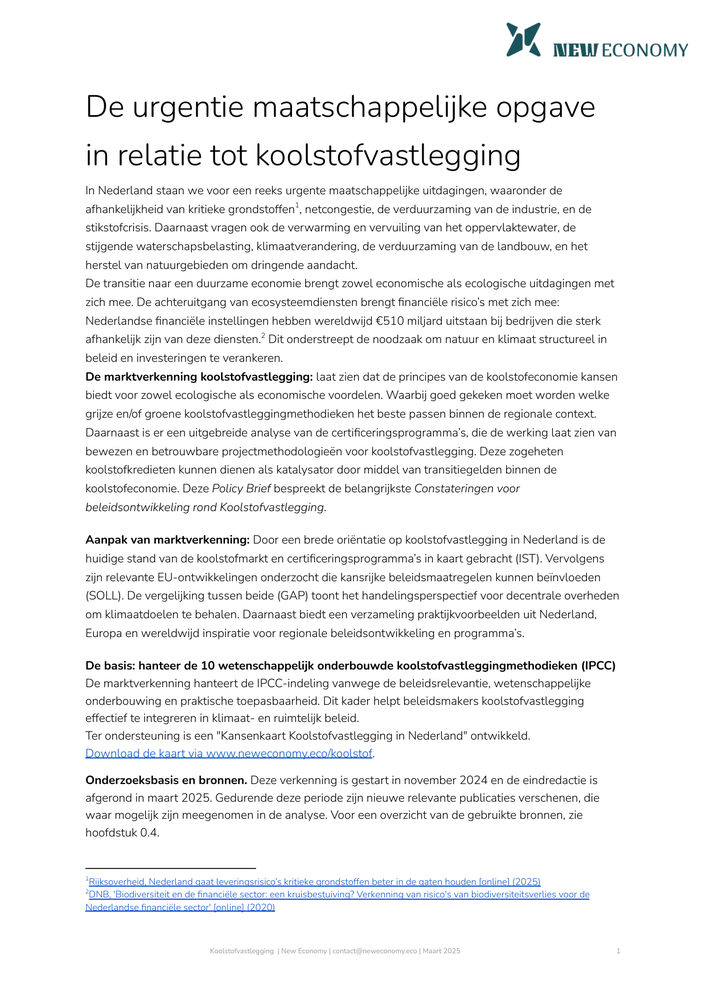
Background and urgency
The Netherlands faces a series of urgent societal challenges: dependence on critical raw materials, grid congestion, making industry more sustainable and the nitrogen crisis. In addition, the warming and pollution of surface water, rising water authority levies, climate change, making agriculture more sustainable and the restoration of natural areas all demand urgent attention. The decline of ecosystem services moreover carries financial risks: according to an exploration by DNB, Dutch financial institutions have €510 billion of exposure worldwide to companies that are strongly dependent on these services.
The underlying market exploration first mapped the current state of the carbon market and certification programmes (IST), then examined relevant EU developments (SOLL) and, from the comparison between the two (GAP), derived the course of action for decentralised authorities. A collection of practical examples from the Netherlands, Europe and worldwide offers inspiration for regional policy development. Carbon credits from proven and reliable project methodologies can serve as a catalyst in this, in the form of transition funding within the carbon economy.
As its basis, the exploration uses the ten scientifically substantiated carbon sequestration methods according to the IPCC classification, on account of their policy relevance, scientific grounding and practical applicability. This framework helps policymakers integrate carbon sequestration effectively into climate and spatial planning policy.
Two foundations for policy
A precondition for concrete steps is that two foundations are first in place.
Foundation 1: set separate targets for emissions reduction and carbon sequestration. Whereas emissions reduction has long had the attention of policymakers, carbon sequestration is a relatively new policy domain. Given its strong correlation with urgent policy challenges (nitrogen, housing construction, climate) and its considerable economic and societal potential, carbon sequestration calls for a strategic policy framework of its own.
Foundation 2: create a coherent assessment framework and distinguish between green and grey sequestration. Natural and technological sequestration each have a different impact and different side effects; clear, area-specific assessment frameworks support strategic choices at regional and national level. The brief recommends taking note of the recommendations from the report ‘Scaling up carbon dioxide removals’ (February 2025) by the European Scientific Advisory Board on Climate Change (ESBCC) and, where possible, translating these into one’s own assessment framework.
Eight courses of action
On the basis of the value and potential of carbon sequestration, the brief identifies eight concrete courses of action:
- I. Knowledge development on carbon sequestration — data makes impact visible; a reliable supply of information fosters awareness, mutual collaboration and the learning capacity of stakeholders.
- II. Promote carbon sequestration for broader societal challenges — natural carbon sequestration can be deployed for the restoration of ecosystems, sustainable agriculture and water management; the Environment and Planning Act (Omgevingswet) and the Nota Ruimte 2026 offer opportunities to embed this structurally.
- III. Safeguard monitoring and registration in sequestration projects — a reliable system for monitoring and registration, comparable to emissions registration, prevents greenwashing; governments set standards and safeguard independent validation.
- IV. Factor a societal carbon price into cost-benefit analyses (SCBA) — the societal value of emissions and sequestration belongs in economic assessments; the brief cites a societal CO2 price of approximately €875 per tonne.
- V. Implement EU CRCF regulation and certification — work with certifiers that comply with the new European CRCF legislation (Carbon Removal & Carbon Farming Regulation) and with international standards such as ISO and the Science Based Targets initiative (SBTi).
- VI. Use carbon markets as a transition instrument — certificates can serve as transition funding to stimulate innovation and share risks, provided they are well regulated so that credits do not become an excuse to continue fossil emissions; certificates must comply with, among others, the Oxford Principles.
- VII. Stimulate innovation programmes for knowledge development, financing and implementation — regions can accelerate the transition together with entrepreneurs, knowledge institutions and civil-society organisations; Regional Development Agencies (Regionale Ontwikkelingsmaatschappijen, ROMs) can link carbon storage in bio-based construction to new revenue models for agriculture.
- VIII. Integrate carbon sequestration into your own operations and procurement — decentralised authorities have an exemplary role; targeted tendering and procurement geared to carbon sequestration, within the framework of Socially Responsible Commissioning and Procurement (Maatschappelijk Verantwoord Opdrachtgeven en Inkopen, MVOI), stimulates early business cases, supply-chain development and innovation.
Relationship with the opportunities map
In support of the IPCC framework, the Opportunities Map for Carbon Sequestration in the Netherlands has been developed; for the map and the full analysis, the brief refers to neweconomy.eco/koolstof. Course of action II also refers to the carbon sequestration house, which shows for each method how carbon sequestration can strengthen societal challenges. The brief’s final page presents both map visuals as a visual summary.
Further reading
This policy brief is part of the Carbon Sequestration project, which includes the full market exploration, the opportunities map and the explanatory document. More reports and maps can be found in the publications overview.
Download the policy brief
- Carbon sequestration policy brief (PDF)Three pages covering the background, two foundations and eight courses of action for policy development. Download the policy brief (PDF, 1.2 MB)
How to cite
New Economy (2025). The urgency of the societal challenge around carbon sequestration (policy brief, March 2025). Available via neweconomy.eco.