
Ten carbon sequestration methods linked to Gelderland policy and opportunities
The Carbon Sequestration House Gelderland (May 2025) is a map in three panels — methods, policy and opportunities — that assesses ten carbon sequestration methods against societal challenges and links them to existing Gelderland policy and concrete opportunities in the province.
Three panels from methods to opportunities
The map assesses ten methods against societal challenges and counts the positive links for each method. The most positive links (23 each) are shown by planting for reforestation & bio-based (construction) materials, restoration of wetlands and blue carbon management. For CCS, DACCS and BECCS with CO2 storage there is an important limitation: Gelderland lacks suitable subsurface. Six user systems (A–F) show who is responsible for each method.
Download the opportunities map (PDF)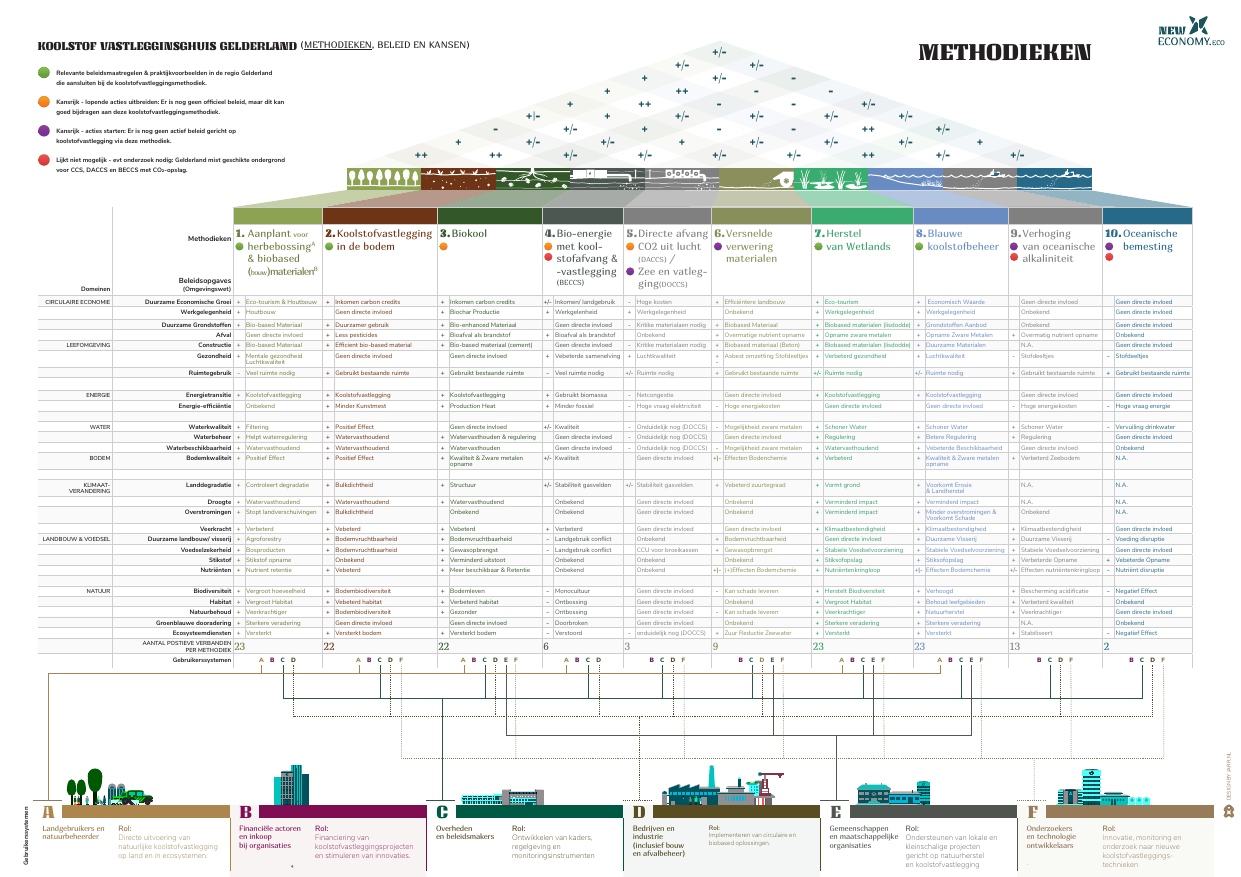
The three panels
The carbon sequestration house gives policymakers insight into the links between carbon sequestration methods and the societal challenges from the National Strategy on Spatial Planning and the Environment (NOVI, 2020); each method is assessed quantitatively and qualitatively against these policy objectives. A colour coding indicates the situation in Gelderland for each method: relevant policy measures and practical examples that already align (green), promising — expand ongoing actions (orange), promising — start actions (purple) and appears not possible, further research may be needed (red).
Panel 1 — Methods
The methods panel assesses the ten methods against policy tasks from the Environment and Planning Act (Omgevingswet), spread across eight domains: circular economy, living environment, energy, water, soil, climate change, agriculture & food and nature. The bottom row counts the number of positive links for each method.
| Method | Positive links |
|---|---|
| 1. Planting for reforestation & bio-based (construction) materials | 23 |
| 2. Carbon sequestration in the soil | 22 |
| 3. Biochar | 22 |
| 4. Bio-energy with carbon capture & storage (BECCS) | 6 |
| 5. Direct capture of CO2 from air (DACCS) / sea (DOCCS) | 3 |
| 6. Enhanced weathering of materials | 9 |
| 7. Restoration of wetlands | 23 |
| 8. Blue carbon management | 23 |
| 9. Enhancement of ocean alkalinity | 13 |
| 10. Ocean fertilisation | 2 |
Number of positive links per method, counted across the policy tasks of the methods panel (p. 1 of the map).
Panel 2 — Policy
The policy panel links the methods to existing Gelderland policy and existing practice, organised into five domains of the climate approach: energy, industry and business, built living environment, agriculture & land use and mobility. Recurring policy instruments include the Omgevingsvisie Gaaf Gelderland (Gelderland Environmental Vision), the Gelders Programma Klimaat 2021-2030 (Gelderland Climate Programme, updated in 2024), the Gelders Uitvoeringsprogramma Circulaire Economie 2025-2027 (Gelderland Circular Economy Implementation Programme), Agro Building Carbon (ABC) and Vitaal Landelijk Gebied Gelderland (PPLG). For agriculture and land use there are, among others, the Uitvoeringsprogramma Bomen en Bos (Trees and Forest Implementation Programme), the Natuurbeheerplan 2025 (Nature Management Plan 2025), the Herstelprogramma Bossen (Forest Restoration Programme), the Herstelprogramma Vennen en Venen (Fens and Bogs Restoration Programme), Levende Rivieren (Living Rivers, ARK Rewilding), LIFE CO2SAND and Slim Landgebruik (Smart Land Use). Energy and industry include Groen Gas Gelderland (Green Gas Gelderland) and the AVR facility in Duiven (CCU); the policy panel links no existing instruments to mobility.
Panel 3 — Opportunities
The opportunities panel translates the methods into concrete opportunities in Gelderland. For the natural methods, this is mainly about expanding ongoing actions and supporting policy with well-developed monitoring and certification, including rewarding landowners through certification and a new revenue model for farmers with carbon certification. Concrete applications include biochar in construction material (concrete and asphalt), biochar against salinisation and on agricultural land, olivine in concrete and in cycle and footpaths, and BECCS for heat networks, residual streams and locally on the farm. For wetlands the focus is currently mainly on forest policy, while there are also opportunities around carbon in peat areas; for blue carbon, opportunities lie in nature restoration in river areas. The AVR facility in Duiven is well operational for large-scale CO2 capture for CCU; CCS is not yet applied and has no active policy as yet. DACCS and the two ocean methods appear geographically not applicable within the province; there, opportunities lie mainly in innovation programmes where companies start the application outside the province. For practical examples from the Netherlands, Europe and worldwide, the map refers to chapter 1.1 of the full report.
User systems A–F
For each method, the map shows which of six user systems are responsible:
| User system | Role | |
|---|---|---|
| A | Land users and nature managers | Direct implementation of natural carbon sequestration on land and in ecosystems |
| B | Financial actors and procurement within organisations | Financing of carbon sequestration projects and stimulating innovations |
| C | Governments and policymakers | Developing frameworks, regulation and monitoring instruments |
| D | Businesses and industry (including construction and waste management) | Implementing circular and bio-based solutions |
| E | Communities and civil-society organisations | Supporting local and small-scale projects aimed at nature restoration and carbon sequestration |
| F | Researchers and technology developers | Innovation, monitoring and research into new carbon sequestration techniques |
Notable outcomes
The analysis shows, particularly for natural carbon sequestration, positive links with several societal objectives at once: clean water, healthy food, materials for bio-based housing construction and new economic opportunities, with a link towards lower emissions in the case of nitrogen. Technological sequestration more often relates to a single objective and, in the case of nitrogen, sometimes shows a temporary negative link. Planting for reforestation & bio-based (construction) materials, restoration of wetlands and blue carbon management score highest, with 23 positive links each; ocean fertilisation (2), DACCS/DOCCS (3) and BECCS (6) the lowest.
The carbon sequestration house was compiled between November 2024 and March 2025 (final editing: March 2025); owing to rapid developments in the carbon market, information may since have changed. The pluses and minuses shown are qualitative and quantitative assessments of links per policy objective, not calculated effects. When selecting methods, an integrated assessment is advisable; the carbon sequestration house provides an assessment framework for this.
Further reading
This opportunities map is part of the Carbon Opportunities for Gelderland project and builds on the national Carbon Sequestration project, where the full analysis and the accompanying policy brief can also be found. More reports and maps can be found in the publications overview.
Download the opportunities map
- Carbon Sequestration House Gelderland (PDF)Map in three panels: methods, policy and opportunities, with user systems A–F. Download the opportunities map (PDF, 0.8 MB)
Design: JARR.NL.
How to cite
New Economy (2025). Carbon Sequestration House Gelderland: methods, policy and opportunities. Available via neweconomy.eco.