Gelderland Climate Opportunities Map 2025 · method

Method: TTW versus WTW

The Snapshot & Reflection 2025 uses two system boundaries side by side. Emissions reporting follows TTW: direct emissions within provincial boundaries. The reduction potential of solutions follows WTW: full chain emissions from source to use.

Download methodological appendix   Download WTW and TTW comparison

Reading guide data and snapshot

Publication March 2025

Two data moments

The analysis is based on emissions data up to and including 2022 and 2023. Reporting data lags several years behind the publication date, so each edition uses the most recent fully available data years. This snapshot reflects on the Gelderland Climate Opportunities Map 2023-2024, which was based on data up to and including 2021.

The 2025 publication does not replace the earlier Climate Opportunities Map. The Gelderland Climate Opportunities Map 2023-2024 remains the planning and potential layer. The Snapshot & Reflection 2025 adds a progress layer: implementation, traction, remaining gap and attention points towards 2030.

Emissions accounting Tank-to-Wheel and Well-to-Wheel

For transport, energy and energy carriers, the system boundary determines which part of the emissions is included. TTW records direct emissions during use. WTW also includes upstream emissions, such as extraction, production, refining, transport, distribution and electricity generation.

WTW · Well-to-Wheel = WTT + TTW WTT Well-to-Tank TTW Tank-to-Wheel Source Tank Wheel extraction · production · refining · transport · distribution direct emissions during use For a battery-electric vehicle, TTW is zero; emissions sit in WTT, depending on the electricity mix.
WTT
Well-to-Tank

Upstream emissions before use: extraction, production, refining, transport and distribution of the fuel up to the tank or charging point. For electricity, this refers to emissions from electricity generation.

TTW
Tank-to-Wheel

Direct emissions from the use of fuel or energy in a vehicle, building, installation or process. In emissions reporting, this refers to direct emissions within provincial boundaries.

WTW
Well-to-Wheel

Total greenhouse gas emissions across the chain, from source to use. WTW is the sum of WTT and TTW and makes the effect of different solutions easier to compare.

Why two system boundaries are needed

Gelderland’s emissions trend is reported on the basis of TTW, because this method aligns with direct emissions within provincial boundaries and with the methodology of emissieregistratie.nl. The potential impact of solutions is calculated on the basis of WTW, because climate measures often affect the full energy chain.

This separation prevents methodological confusion. TTW shows what is emitted directly within Gelderland. WTW shows how much emissions a measure can actually avoid when the chain before use is also included.

Link with the GHG Protocol. Direct combustion falls under scope 1, purchased electricity under scope 2 and upstream chain emissions under scope 3. See also What is the GHG Protocol?.

The difference in Gelderland

WTW is typically around 5 to 10% higher than TTW, because upstream emissions are included. For Gelderland, the difference is approximately 9% in the estimate and approximately 5% in the ambitious scenario. The actual chain impact is therefore higher than the direct TTW figure indicates.

ComponentMethod usedFunction in the analysis
Historical emissionsTTWRegistration of direct emissions within provincial boundaries, based on emissieregistratie.nl.
Reduction potential of solutionsWTWComparable calculation of chain effects per measure, from source to use.
Progress towards 2030TTW plus WTW explanationImplementation is assessed against registered emissions; solution effects are explained through chain impact.
Carbon storageSeparate reportingCO2 storage is reported next to emissions reduction, so avoided emissions and stored carbon are not mixed.

Avoiding double counting

The method does not double count potential and realised emission reductions. Only implemented measures count as solutions. Potentials remain scenario estimates for 2030 and are not added to registered emission reductions as if they had already been realised.

This keeps three layers visible: realised emissions development, the remaining implementation challenge and additional reduction or carbon storage potential.

Drawdown and Pareto

The Climate Opportunities Map uses Drawdown logic to order proven climate solutions by their potential for emissions reduction and carbon storage. For each solution, the possible contribution towards 2030 becomes visible.

A Pareto approach then helps prioritise the largest emission sources and the largest solution opportunities. In Gelderland, this puts emphasis on high-impact measures such as rooftop solar, zero-emission vehicles, onshore wind, ground-mounted solar and energy efficiency in industry.

Appendices and downloads

Methodological substantiation

Traceable for each SMART solution

The assumptions, source references and calculations for each SMART solution are included in the methodological appendix. The additional spreadsheet compares WTW and TTW and makes the applied system boundary auditable.
Download PDF   Download XLSX

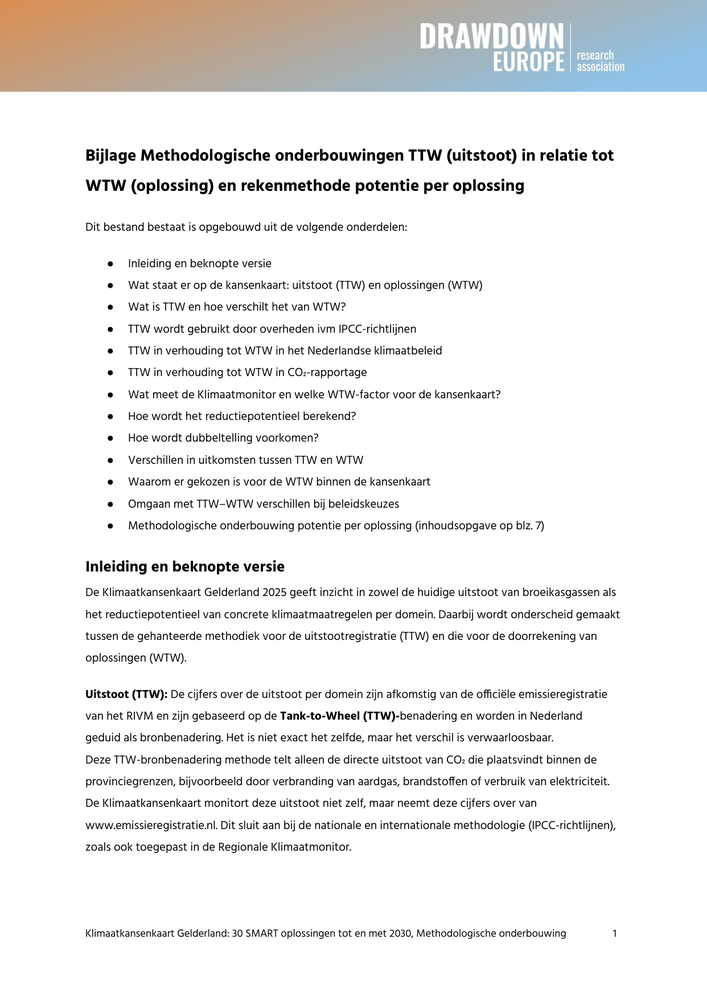
Cover of the methodological appendix for the Gelderland Climate Opportunities Map 2025

Methodological appendix

Substantiation of potential per solution, including assumptions and source references.

Open appendix

WTW and TTW comparison

Spreadsheet comparing Well-to-Wheel and Tank-to-Wheel for the calculations used.

Open spreadsheet

Further reading within the project family

Gelderland Climate Opportunities Map
/projecten/klimaatkansenkaart-gelderland/

Planning and potential layer with 30 SMART solutions, scenarios and reduction potential up to 2030.

PCSA Gelderland
/projecten/klimaatoplossingen-gelderland/

Historical foundation and first sectoral exploration of climate solutions for Gelderland.

Carbon opportunities for Gelderland
/projecten/koolstofkansen-voor-gelderland-landbouw-leefomgeving-en-circulariteit/

Exploration of carbon storage in agriculture, the living environment and circularity.

Gelderland 2025 sector pages
to be linked after publication

Energy, built environment, agriculture and land use, mobility and industry.

FAQ about TTW and WTW

What is the difference between TTW and WTW?

TTW stands for Tank-to-Wheel and includes direct emissions during use. WTW stands for Well-to-Wheel and includes both upstream emissions and direct emissions during use.

Why are emissions and solutions calculated differently?

Emissions reporting needs a clear territorial boundary and therefore uses TTW. Analysis of climate solutions requires insight into the full chain effect and therefore uses WTW.

How much higher is WTW than TTW in Gelderland?

WTW is typically around 5 to 10% higher than TTW. For Gelderland, the difference is approximately 9% in the estimate and approximately 5% in the ambitious scenario.

How is double counting prevented?

Historical emissions, implemented measures and future solution potential are kept separate. Potentials are not counted as realised reductions until measures have actually been implemented.

Scroll naar boven
ite nodig; verwijder dit snippet en de pagina is exact terug bij af. Plaatsing: WPCode -> nieuw snippet -> type HTML -> Footer / site-wide. De guard hieronder beperkt het tot pagina 8365 (Utrecht). ============================================================ */ (function(){ "use strict"; function init(){ var b = document.body; if(!b) return; // GUARD: alleen op de pilotpagina (single project, postid-8365) if(!b.classList.contains("single-project") || !b.classList.contains("postid-8365")) return; // idempotent: niet dubbel bouwen if(document.querySelector(".ne-leesbalk")) return; var root = document.querySelector(".ne-rd"); if(!root) return;// --- hoofdstukken: echte ankers, over containers heen, in leesvolgorde --- var sel = ".ne-rd .rd-report > section[id], .ne-rd .report > section[id], .ne-rd .huisband[id], .ne-rd .ne-inzichtenband[id], .ne-rd #gerelateerd"; var nodes = [].slice.call(document.querySelectorAll(sel)); // dedupe + documentvolgorde nodes = nodes.filter(function(n,i){ return nodes.indexOf(n) === i; }); nodes.sort(function(a,c){ return (a.compareDocumentPosition(c) & 2) ? 1 : -1; }); if(nodes.length < 2) return;var hoofdstukken = nodes.map(function(n){ var h = n.querySelector("h2"); var t = h ? h.textContent.replace(/\s+/g," ").trim() : (n.id || "Hoofdstuk"); return { id:n.id, titel:t, el:n }; }); var total = hoofdstukken.length, current = 0;// --- #downloads-fix: de downloadband heeft geen id, knoppen linken er wel naar --- if(!document.getElementById("downloads")){ var dl = document.querySelector(".ne-rd .dlband"); if(dl) dl.id = "downloads"; }// --- CSS injecteren (identiek aan het toekomstige post-31-blok) --- var css = "" +"@media(max-width:760px){" +"body.single-project:has(.ne-leesbalk) .ne-rd .rd-report p,body.single-project:has(.ne-leesbalk) .ne-rd .report p{font-size:16px;line-height:1.78;color:#243b3e;margin:0 0 14px}" +"body.single-project:has(.ne-leesbalk) .ne-rd .rd-report h2,body.single-project:has(.ne-leesbalk) .ne-rd .report h2{font-size:21px;margin:22px 0 8px}" +"body.single-project:has(.ne-leesbalk) .ne-rd .rd-report{max-width:62ch}" +"body.single-project:has(.ne-leesbalk) .ne-rd .inzet-label{font-family:'Unlock',sans-serif;font-size:10px;letter-spacing:.09em;color:#159b86;margin:6px 0 8px}" +"}" +"@media(max-width:900px){body.single-project:has(.ne-leesbalk) .ne-rd .rd-toc{display:none}}" +"@media(max-width:900px){" +"body.single-project:has(.ne-leesbalk) .site-main{padding-bottom:72px}" +"body.single-project:has(.ne-leesbalk) .ne-rd .huisband[id],body.single-project:has(.ne-leesbalk) .ne-rd .ne-inzichtenband[id],body.single-project:has(.ne-leesbalk) .ne-rd #gerelateerd{scroll-margin-top:120px}" +".ne-leesbalk{position:fixed;left:0;right:0;bottom:0;z-index:1200;display:flex;align-items:center;gap:10px;padding:9px 12px;background:#0f3b42;padding-bottom:calc(9px + env(safe-area-inset-bottom))}" +".ne-leesbalk .lb-btn,.ne-leesbalk .lb-arrow{display:grid;place-items:center;width:36px;height:36px;border-radius:10px;background:rgba(255,255,255,.1);color:#9cfffa;flex:0 0 auto;text-decoration:none;border:0;cursor:pointer}" +".ne-leesbalk .lb-btn svg,.ne-leesbalk .lb-arrow svg{width:20px;height:20px}" +".ne-leesbalk .lb-mid{flex:1;min-width:0}" +".ne-leesbalk .lb-pos{font-size:12.5px;color:#fff;white-space:nowrap;overflow:hidden;text-overflow:ellipsis}" +".ne-leesbalk .lb-prog{height:3px;border-radius:2px;background:rgba(255,255,255,.15);margin-top:5px;overflow:hidden}" +".ne-leesbalk .lb-prog i{display:block;height:100%;width:0;background:#47e23c;border-radius:2px;transition:width .25s}" +".ne-leesbalk .lb-nav{display:flex;gap:6px;flex:0 0 auto}" +".lb-overlay{position:fixed;inset:0;z-index:1250;background:rgba(15,59,66,.4);opacity:0;visibility:hidden;transition:opacity .28s ease}" +".lb-overlay.is-open{opacity:1;visibility:visible}" +".ne-leessheet{position:fixed;left:0;right:0;bottom:0;z-index:1300;background:#fff;border-radius:18px 18px 0 0;transform:translateY(110%);transition:transform .28s ease;box-shadow:0 -8px 24px rgba(15,59,66,.18);max-height:70vh;overflow:auto;padding-bottom:calc(8px + env(safe-area-inset-bottom))}" +".ne-leessheet.is-open{transform:translateY(0)}" +".lb-grip{display:block;width:38px;height:4px;border-radius:3px;background:#d4dedc;margin:9px auto 2px}" +".lb-sheethead{display:flex;align-items:center;justify-content:space-between;padding:8px 16px 6px;font-family:'Marmelad',serif;font-size:17px;color:#1a535c}" +".lb-close{font-size:24px;color:#8aa4a7;cursor:pointer;line-height:1;border:0;background:0;padding:0 4px}" +".lb-ch{display:flex;align-items:center;gap:12px;padding:12px 16px;border-top:1px solid #f0f4f3;text-decoration:none}" +".lb-ch .n{font-family:'Marmelad',serif;font-size:15px;color:#9bb3b6;flex:0 0 26px;text-align:center}" +".lb-ch .t{font-size:14px;color:#243b3e}" +".lb-ch.is-current{background:#e7f7f2;border-top-color:#cdeee5}" +".lb-ch.is-current .n{color:#159b86}" +".lb-ch.is-current .t{color:#0f3b42;font-weight:700}" +"}" +"@media(min-width:901px){.ne-leesbalk,.ne-leessheet,.lb-overlay{display:none}}"; var st = document.createElement("style"); st.id = "ne-leesbalk-css"; st.textContent = css; document.head.appendChild(st);// --- iconen --- var icoLijst = ''; var icoOmhoog = ''; var icoOmlaag = '';// --- balk --- var bar = document.createElement("div"); bar.className = "ne-leesbalk"; bar.setAttribute("aria-label","Leesbalk"); bar.innerHTML = '' +'
Hoofdstuk 1 / '+total+'
' +'
' +''+icoOmhoog+'' +''+icoOmlaag+'' +'
';// --- sheet --- var sheet = document.createElement("nav"); sheet.className = "ne-leessheet"; sheet.setAttribute("aria-label","Inhoudsopgave"); var rows = '' +'
Inhoudsopgave
'; hoofdstukken.forEach(function(h,i){ var nr = (i+1<10?"0":"")+(i+1); rows += ''+nr+''+h.titel+''; }); sheet.innerHTML = rows;var overlay = document.createElement("div"); overlay.className = "lb-overlay";b.appendChild(bar); b.appendChild(overlay); b.appendChild(sheet);var pos = bar.querySelector(".lb-pos"); var prog = bar.querySelector(".lb-prog i"); var arrows = bar.querySelectorAll(".lb-arrow"); var chs = [].slice.call(sheet.querySelectorAll(".lb-ch"));function setCurrent(i){ current = Math.max(0, Math.min(total-1, i)); if(pos) pos.textContent = "Hoofdstuk "+(current+1)+" / "+total; if(prog) prog.style.width = Math.round((current+1)/total*100)+"%"; chs.forEach(function(c,k){ c.classList.toggle("is-current", k===current); }); if(arrows[0]) arrows[0].setAttribute("href","#"+hoofdstukken[Math.max(0,current-1)].id); if(arrows[1]) arrows[1].setAttribute("href","#"+hoofdstukken[Math.min(total-1,current+1)].id); } setCurrent(0);// live positie if("IntersectionObserver" in window){ var io = new IntersectionObserver(function(entries){ entries.forEach(function(e){ if(e.isIntersecting){ var idx = hoofdstukken.findIndex(function(h){ return h.el === e.target; }); if(idx > -1) setCurrent(idx); } }); }, { rootMargin:"-45% 0px -45% 0px", threshold:0 }); hoofdstukken.forEach(function(h){ io.observe(h.el); }); }// open / sluit function open(){ overlay.classList.add("is-open"); sheet.classList.add("is-open"); } function close(){ overlay.classList.remove("is-open"); sheet.classList.remove("is-open"); } bar.querySelector(".lb-btn").addEventListener("click", open); overlay.addEventListener("click", close); sheet.querySelector(".lb-close").addEventListener("click", close); chs.forEach(function(c){ c.addEventListener("click", close); }); }if(document.readyState === "loading"){ document.addEventListener("DOMContentLoaded", init); } else { init(); } })();