
From idea to experiment
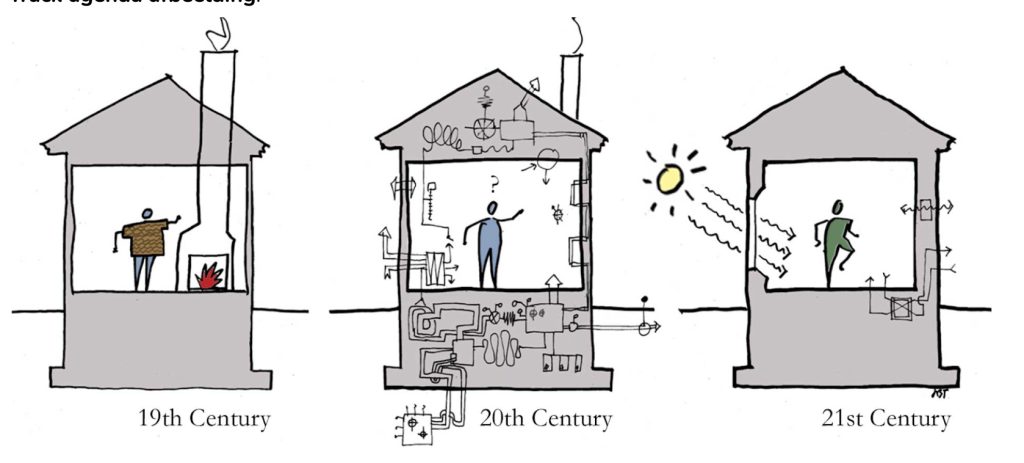
Meeting climate and energy targets calls for a substantial renovation effort. At the same time, critical raw materials are under pressure, and the circular economy asks for less material use and higher steps on the R-ladder. New Economy therefore carried out a market exploration of low-tech renovation solutions, looking at smart design choices, lifespan extension and other system-level choices at building and area scale.
The exploration surfaced seven building blocks: envelope-first, right-sizing, avoiding cooling demand, natural ventilation / low-tech, collective organisation, a life-cycle business case and breaking through system barriers. These form the foundation for three experiments in which Refuse and Rethink are applied as a design principle.
From exploration to experiment
Across three sessions, New Economy shares the insights from the exploration and presents the next step: pilots, design tracks and chain collaboration. The sessions show how Refuse and Rethink can be applied in renovation and how organisations can take part.
Experiment 1 – Refuse in long-term maintenance plans (MJOP)
Many long-term maintenance plans (MJOP) assume fixed replacement cycles, so installations and components are replaced prematurely. This experiment examines how owners’ associations and property managers can integrate Refuse principles:
- Postpone replacement responsibly and make repair or modular replacement the standard.
- Normalise maintenance before new purchase and organise collective provisions instead of individual installations.
- Explore new service and risk-sharing models that make postponement financially attractive.
Pilot locations are selected, maintenance plans analysed, scenarios with less material use designed and ‘share & reduce’ pilots developed. Success is measured in material impact (kilograms and Whole Life Carbon), comfort, cost and resident acceptance.
Experiment 2 – Refuse as a design question
In this experiment, artists, designers, small and medium-sized enterprises and students receive a design brief: cut, combine, collectivise and redefine – optimising is not allowed. The aim is to create more comfort with fewer critical materials. Think of modular shading, natural ventilation, thermal mass or biobased solutions. The most radical concepts are developed into pilots; municipalities can act as a launching customer.
Experiment 3 – CIRCO chain track
Together with chain partners, New Economy develops a CIRCO chain track in which participants work on propositions around:
- Envelope-first and right-sizing of installations,
- Collectivising instead of individualising,
- Steering on Whole Life Carbon.
During a two-day track spread over several months, participants learn to design interventions, substantiate their impact with whole-life carbon assessment (WLCA) and total cost of ownership (TCO), and translate these into viable business models and pilots. The output is captured in a Refuse playbook.
Why Refuse?
Refuse does not mean standing still, but making choices that lead to less dependence on critical materials, less material use and more system resilience in the built environment. Approaching renovation this way produces solutions that fit better in a circular economy, and it responds directly to material scarcity as a design challenge.
Take part
The exploration has since been translated into opportunity maps and concrete pilots. Want to think along, take part or offer a pilot location? See Circular business or Contact to explore the options. Together this pioneers a built environment that offers more comfort with fewer materials.
Frequently asked questions about renovating with fewer critical materials
Designing renovations that reduce dependence on critical raw materials by using fewer materials and climbing higher up the R-ladder, with smart design choices, lifespan extension and system-level decisions.
Refuse means making choices that lead to less material use and less dependence on critical materials: postponing replacement responsibly, organising collective provisions and steering on Whole Life Carbon, rather than standing still.
Seven emerged from the market exploration: envelope-first, right-sizing, avoiding cooling demand, natural ventilation or low-tech, collective organisation, a life-cycle business case and breaking through system barriers.
In material impact (kilograms and Whole Life Carbon), comfort, cost and resident acceptance, substantiated with whole-life carbon assessment (WLCA) and total cost of ownership (TCO).
By reducing material use and dependence on critical materials, renovation choices climb the R-ladder and strengthen system resilience in the built environment.
To work on low-tech, material-light renovation, see Circular business or Contact to explore the options.
{ “@context”: “https://schema.org”, “@graph”: [ { “@type”: “Article”, “@id”: “https://neweconomy.eco/en/renovating-with-fewer-critical-materials/#article”, “isPartOf”: { “@id”: “https://neweconomy.eco/en/renovating-with-fewer-critical-materials/#webpage” }, “mainEntityOfPage”: { “@id”: “https://neweconomy.eco/en/renovating-with-fewer-critical-materials/#webpage” }, “headline”: “Renovating with fewer critical materials”, “description”: “A market exploration of low-tech renovation solutions that apply Refuse and Rethink to the built environment: less material use, higher up the R-ladder and more system resilience.”, “inLanguage”: “en”, “author”: { “@id”: “https://neweconomy.eco/#organization” }, “publisher”: { “@id”: “https://neweconomy.eco/#organization” } } ] }