
Carbon sequestration
Carbon sequestration is the removal of CO2 from the atmosphere and storage in soil, biomass, nature, water or long-lived materials. The Dutch market exploration estimates that natural carbon sequestration represents around €31 billion in societal value per year, rising to €429 billion up to 2050. Methods such as afforestation, regenerative agriculture, biobased construction and biochar can together sequester around 36 Mton CO2 per year. The strongest value comes from using carbon as an organising principle for economy and ecology, not from treating sequestration as a licence to continue emissions.
Do not compensate, create
The exploration shows that natural carbon sequestration is promising, viable and applicable in the short term. Green sequestration is generally repeatable, supports sustainable earning models and can deliver a return of 7 to 30 times the investment. The largest value emerges when sequestration creates new value in agriculture, construction and nature, rather than offsetting existing emissions.
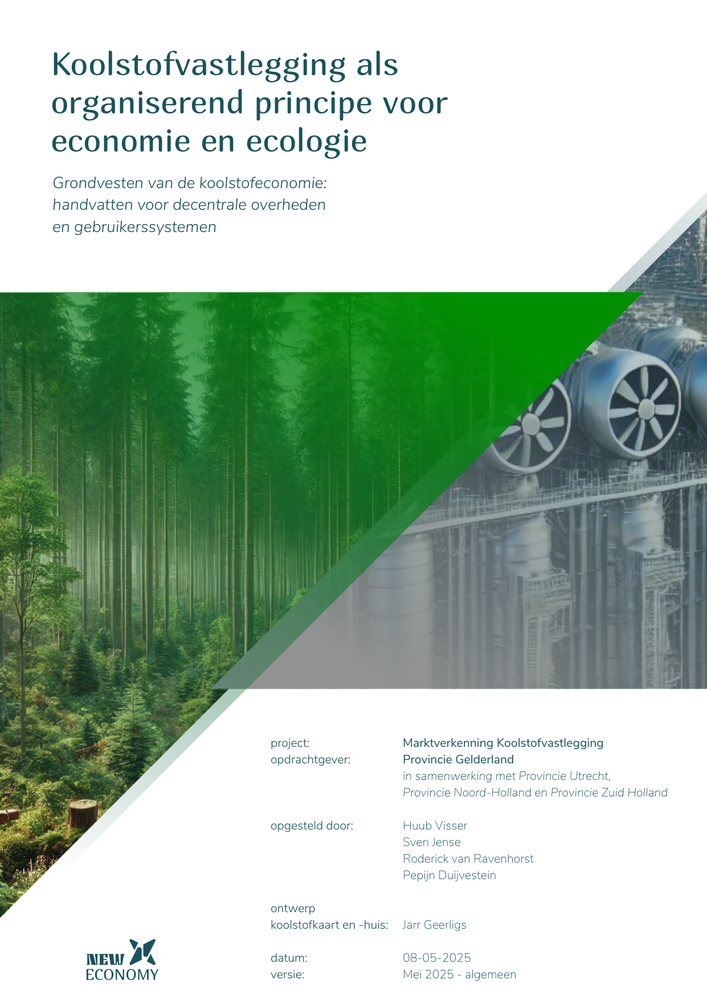
In brief
Carbon sequestration removes CO2 from the atmosphere and stores carbon in soil, biomass, nature, water and long-lived materials. For the Netherlands, the combined societal value of natural sequestration is estimated at around €31 billion per year, rising to €429 billion up to 2050.
The exploration organises the opportunities across ten internationally recognised methods based on the IPCC system, identifies potential and value per method, and translates this to regional opportunities. The central message is reduce first: carbon sequestration is strongest when emission reduction remains the priority and sequestration creates durable value in agriculture, construction and nature.
Reduce first, then sequester
Carbon sequestration should not be treated as permission to compensate existing emissions cheaply. The report positions sequestration as an additional climate and transition strategy. Reduction remains the first step; sequestration strengthens the transition when connected to soil quality, biodiversity, water, biobased materials and circular business models.
Related explainer: CCS, CCU, BECCS and CDR explained. Related opinion: Do not compensate, create: nature-based solutions.
Ten methods
The report follows ten IPCC-based methods. The main natural routes include afforestation, regenerative agriculture, biobased construction and biochar. The exploration distinguishes natural green sequestration from technological grey sequestration, including CCS, CCU, BECCS and carbon dioxide removal (CDR).
Regional explorations
The national exploration is translated into provincial opportunities. Regional carbon sequestration explorations are available for the following provinces:
Downloads and source files
Carbon sequestration is the removal of CO₂ from the atmosphere and storage in soil, biomass, nature, water or long-lived materials.
No. The report uses a reduce-first position: emission reduction remains the priority, while sequestration creates additional value in agriculture, construction and nature.
The exploration uses ten IPCC-based methods, including afforestation, regenerative agriculture, biobased construction and biochar.
Natural carbon sequestration in the Netherlands represents an estimated societal value of around €31 billion per year, rising to €429 billion up to 2050.