
Trias Emergetica: three principles for circular resource use
The Trias Energetica (RVO, 2013) is widely used in the energy transition. This is a rule of thumb that can be used to achieve the most sustainable energy supply possible. Composed of three separate steps, the Trias Energetica supports the selection process with a rule of thumb.
Principles of the Trias Energetica
Step 1: Limit energy demand
Step 2: Use renewable energy sources
Step 3: Use finite (fossil) energy sources efficiently
Circular Economy: rules of thumb for material use
In the circular economy, similar questions arise when selecting raw materials to fulfill a specific function. For each product developed, designers consider which raw materials to choose, a choice that has various impacts (CO2 emissions, price, pollution, scarcity). The 10R strategies for circularity (PBL, 2017) help manufacturers consider the application of raw materials and the possibilities for reuse. This offers interesting perspectives and new perspectives for innovation and material applications.
The Trias Energetica is widely applied and offers a solid framework for considering sustainable energy supply. However, the same principles apply to choosing materials. Therefore, as a supplement to the Trias Energetica, we are introducing the Trias Emergetica* for circularity.
Principles of the Triassic Emergetica
Step 1. Limit the demand for materials
Step 2. Use materials from renewable sources
Step 3. Use finite materials efficiently and in high-quality applications

A reused model is nice, but what use is it to us?
The principles of the Trias Emergetica help designers make choices about the application of materials. These principles can be used in combination with the 10R strategies by using each step within one of the Rs. In this blog post, the principles of the Trias Emergetica will be applied to various components of a building. The schematic building envelopes in the 6 Ss of Steward Brand (How Buildings Learn, 1994) will serve as an analytical basis. Each envelope requires different choices regarding the use of materials, products, and energy applications. The image below provides an example of a choice for each envelope, linked to one of the rules of thumb from the Trias Emergetica.
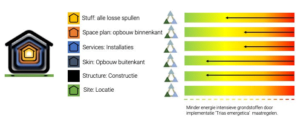
Stuff – all loose items that enter a building
Space Plan – interior structure of a building
- Carpet consumes a lot of energy in production and is difficult to reuse.
- On the other hand, wooden floors are more reusable and store CO2 with lower energy consumption. For example, wood has a negative impact on CO2 production (storage) while carpet has a positive impact (emissions)** (Mahalle et al., 2011).
Services – installations in a building
- Central heating boilers are still widely sold, even though the transition to natural gas-free neighborhoods is well underway. Central heating boilers consume large amounts of natural gas to heat homes, and therefore use a lot of (fossil) raw materials.
- Depending on the home, it's also possible to switch to a ground source heat pump. This can avoid up to 50% of CO2 emissions compared to a central heating boiler (approximately 1000 kg of CO2 emissions) (Milieu Centraal, 2019). A heat pump uses electricity, which is generated more efficiently in power plants, by wind turbines, and solar panels.
Skin – the exterior structure of a building
- Many window frames are currently made of aluminum. Aluminum is easily recyclable, but it doesn't offer the right thermal insulation properties and is energy-intensive to produce.
- Wooden frames** are less energy intensive and have a 20 times lower CO2 impact than aluminium frames.
Structure – construction of a building
- The production of steel and concrete is very energy intensive, yet many construction projects in the Netherlands use these materials.
- The net emissions of a concrete building are 870 tonnes, while that of a wooden building is only 34 tonnes.
Site – location of a building
- The site itself is "eternal." The surrounding area is constantly changing, requiring flexibility (and modularity) so buildings can adapt to their surroundings.
- The considerations for the use of materials are always context-dependent. For example, the impact of locally sourced, non-renewable materials can be lower than materials from renewable sources that must be transported over long distances.
What is the use of a Trias Emergetica?
The goal of the Trias Emergetica is to ultimately achieve the highest possible functional fulfillment using materials with the lowest possible embodied energy over the longest possible period. In this way, the Trias Emergetica supports the choices that lead to the highest possible application of raw materials, components, and products. Curious about the companies that are already consciously considering this? Take a look at our home page.
Bibliography
*Emergy is the amount of energy directly and indirectly consumed in developing a product or service.
**It is important that the wood is from responsible felling.
 English
  Dutch
Dutch